





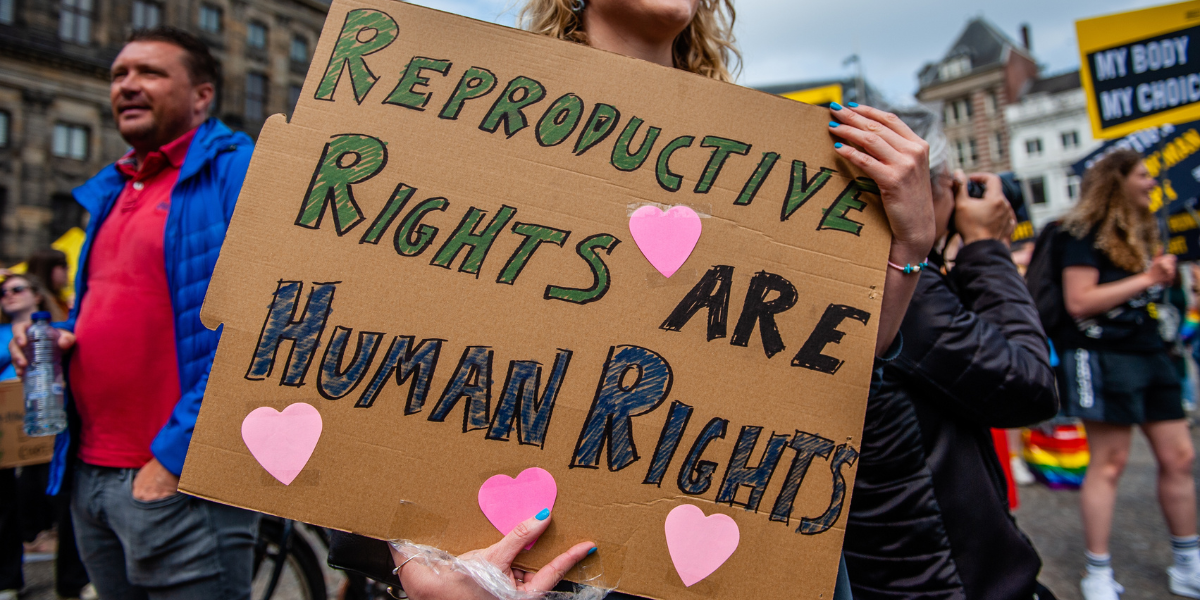
feature image photo by SOPA Images / Contributor via Getty Images
The ultrasound mouse’s clicking is seared into my brain. Our midwife with one hand pressing the transducer into my wife’s stomach, the other hand rolling a finger over the ball in the center of the machine’s keyboard and pressing down, clicking over and over on what was supposed to be our eventual baby’s heartbeat. We had heard it — that magical thump-thump — at each check-up since six weeks. But now, at our ten-week check-up, silence, apart from the midwife’s hollow clicking.
“Let me get the doctor,” she said.
When the doctor came in, more empty clicking.
My wife and I had completed our first round of reciprocal IVF, an increasingly popular method for queer and trans couples to conceive. My embryo, fertilized with our donor’s sperm, had been successfully implanted in her uterus. Sometimes referred to as “co-IVF,” reciprocal IVF is a prime example of reproductive healthcare essential for many LGBTQ+ folks, even though we are often left out of the broader conversation about reproductive rights.
The pee sticks, the blood tests, the doctors all told us my wife was pregnant. Only now, we were learning she had suffered a missed miscarriage at around nine weeks.
A missed miscarriage is one where the fetus has stopped developing or no longer has a heartbeat, but no physical symptoms have signaled the end of the pregnancy. Rather than experiencing pain or bleeding, missed miscarriages are generally discovered at routine ultrasound scans. While it is estimated that nearly 20% of pregnancies end in miscarriage, only 2% end in missed miscarriage.
The doctor continued clicking, insisting he could see the fetus but just couldn’t capture the heartbeat.
“We’re gonna have you go over to maternal fetal medicine,” he told us. “Their equipment is better.”
Whether or not he genuinely believed someone else might be able to locate the heartbeat or this was a ploy to pass us off to someone else who would have to pronounce the pregnancy’s end, my wife already sensed the outcome.
She cried as we got in the car to head across the parking lot to the maternal fetal medicine wing of the local hospital.
“Take a deep breath,” I instructed her, trying desperately to hold onto hope, to hold the pieces of her together. “We don’t know if something’s wrong yet, they just want someone else to try.”
But in the dimly lit ultrasound room, the tech confirmed her suspicion.
“Yeah, I’m not seeing a heartbeat,” she told us dryly. “Sorry.”
We had just gotten ourselves to the point of “we’re actually going to have a baby.” When we “graduated” from the fertility clinic to the OBGYN, we slowly stopped holding our breath and started dreaming. We saved nursery décor ideas full of earthy, gender-neutral colors. We calculated what dates we’d take our respective parental leave, hoping my wife would be out of her first-grade classroom for the first half of the year, through the holiday season. We speculated which of my personality traits our kid might inherit: a creative obsession with words, an innate need for organization. We told only those closest to us, and even though we cautioned it was still a little early to celebrate, they were equally excited. Now, here we were in a sterile ultrasound room, staring up at a mounted TV screen learning that the new life we thought we were bringing into the world was in fact, lifeless. In shock at how quickly everything had been taken from us, I held my wife’s hand as she sobbed.
Now that it was officially a missed miscarriage, the doctors presented my wife with three options for handling it: “expectant management” which meant letting it pass naturally, “medical management” which meant taking a pill to speed up the passing, or undergoing a Dilation & Curettage procedure, more commonly known as a D&C. During a D&C, the patient is put under anesthesia and a suction device is inserted into the uterus through the cervix in order to remove the contents of the fetus. In addition to miscarriage removal, a D&C is also a common method for aborting an unwanted or life-threatening pregnancy in the first trimester.
My wife decided quickly and firmly to opt for the D&C. She knew if she passed the fetus naturally or with the help of a pill, bearing the sight of extreme blood loss would traumatize her even further. She was already in such deep emotional pain, she chose not to subject herself to the physical pain — extreme abdominal cramping, backache, nausea — which usually accompanies miscarriage. Instead, she knew the right choice for her was to be put to sleep and wake up with the leftover tissue of the miscarriage removed.
We live in New Jersey, the eighth most progressive state in the US according to World Population Review. Our current governor — as well as our previous governor, who was still in office during our missed miscarriage — believe deeply in reproductive freedom. But in the midst of our own personal tragedy, I couldn’t help but imagine how different, and thus how much more difficult, this process might have been if we lived in a different state.
Since the Supreme Court overturned Roe v. Wade in 2022, 12 states are now considered “hostile” when it comes to abortion laws, meaning the right to abortion is under threat and has no legal protections, and 13 states have definitively outlawed abortion entirely. Which procedures fall under the definition of “abortion” are unclear and vague, making it extremely difficult for medical providers to navigate whether or not to offer D&C for miscarriages. ProPublica has done extensive reporting on doctors in these states and found that many no longer offer surgical removal as an option for miscarriages, even when there is no fetal activity and even when the patient is at high risk for infection, which can lead to major complications. As of December 2024, at least five women had died after not receiving a D&C in time.
Which is to say that if we lived somewhere like Texas, for instance, surgical removal of the no-longer-developing fetus in my wife’s womb, would have been punishable by law. Or she would not have been offered the option at all and, instead, risked further trauma, potential infection, or death.
Perhaps one of the most ill-informed assumptions made by conservatives, and sometimes even well-meaning allies, is that reproductive healthcare does not pertain to the LGBTQ+ community. It is assumed queer people don’t need access to birth control. It is assumed IVF is for straight, cis women with fertility issues. It is assumed abortion rights only impact straight, cis women who get pregnant “by accident” or who decide they cannot raise a child at that given time. Not only does this assumption disregard straight, cis women who suffer missed miscarriages or pregnancy complications that threaten their lives, it completely erases the reproductive experiences of queer and trans people, who can and do get pregnant, who experience miscarriages and missed miscarriages, and who require abortion care. Because state abortion bans have led to the closure of clinics like Planned Parenthood, the Center for American Progress reports that 11% of LGBTQ+ people struggle to find medical providers in 2024. That number increases to 15% for LGBTQ+ people of color, 15% for disabled LGBTQ+ folks, and 17% for trans individuals. Additionally, while abortion bans have caused 1% of non-LGBTQ+ people to travel out of state when seeking abortion and reproductive care, that percentage is larger for LGBTQ+ folks: 4%. That figure jumps to a staggering 15% when it comes to Black LGBTQ+ folks.
And abortion rights are only one piece of the reproductive justice puzzle. Other crucial care that falls under the umbrella of reproductive rights include contraception, STI screenings/treatment, and fertility treatment, all of which effect queer and trans people.
In fact, before my partner and I required abortion care, we had already fought a long, arduous battle to get insurance to cover our fertility treatment. Our insurance provider initially told us they could only provide coverage for IVF once we had “tried at home” for twelve months. This is a standard pre-requisite for many insurance providers when it comes to IVF. Of course, for many same-sex couples, “trying at home” is not an option. Try as I might, I was not going to magically start producing semen. They then purported that we would each need to try and fail 12 rounds of IUI (intrauterine insemination) before they would consider covering IVF. When we explained that this, too, did not apply to our situation since only one of us wanted to carry and since we would be doing reciprocal IVF, an insurance agent responded, “I don’t know what that is.”
We spent onerous hours of our life on the phone with insurance agents who claimed the company “supported everyone’s right to start a family,” also explaining how their policy completely excluded family plans like ours. It was not until I had my therapist write a letter to the company using the term “discrimination” that, suddenly, insurance was able to cover everything.
From a nurse at my first-ever routine pap smear narrowly defining “sexually active” as penetrative intercourse between a cis man and cis woman, to doctors expressing confusion over my wife and I sharing a last name when filling out information at the hospital, I cannot count the amount of times I have been made to feel alienated as a queer, gender-nonconforming person when it comes to reproductive care.
Surprisingly, at the surgery center, a week before Christmas, the nurses who prepped my wife for a D&C were warm and understanding to the two of us. “I’m so sorry,” they said. Then they dressed her in a paper gown and put her under just long enough to vacuum out the dead cells which were once meant to make up our eventual baby. I sat in the waiting room with my mom and finally let myself cry, after days of trying to hold it together and take care of my wife. I sobbed into a tissue and asked why this had happened to us, regretting the hope we so naively allowed ourselves to have.
Still, I am so thankful my wife had access to the care she needed. We did not have to wait until she was deathly ill to undergo the method she preferred. We did not have to be made to feel like we were doing something “illegal.” We did not have to scrounge up money to cross state lines like some kind of fugitives. We had another couple embryos frozen from our first go-round with IVF which we could afford after threatening our insurance company, so we could try again when we were ready.
What makes people in one state more worthy of these rights than others? And what good does it do to exile queer and trans folks from yet another set of human rights?
Reproductive rights are intertwined tightly with LGBTQ+ rights; they always have been. As the National LGBTQ Task Force states: “Although many people talk about reproductive health as a “women’s issue,” many LGBTQ people—including lesbian and bisexual women, transgender men, two-spirit, intersex, nonbinary and gender non-conforming individuals—can get pregnant, use birth control, have abortions, carry pregnancies, and become parents. Our ability to live our lives fully and to not be discriminated against are dependent on each other’s mutual progress.”
Queer and trans people like me have been acutely aware of this interconnectedness for quite some time. I have been living it every single day since the moment we decided we wanted to start a family of our own. Now, we are once again waiting for everyone else to catch up.





Comments
Thank you for this moving and important piece. I’m so sorry you had this experience.
Great article..
I think IVF companies often don’t give all the info they should. A study last year suggested reciprocal IVF comes with higher risks for both mother and baby, but this has been glossed over by a lot of IVF companies.
https://www.kcl.ac.uk/news/co-ivf-pregnancies-may-come-with-higher-rates-of-serious-complications