





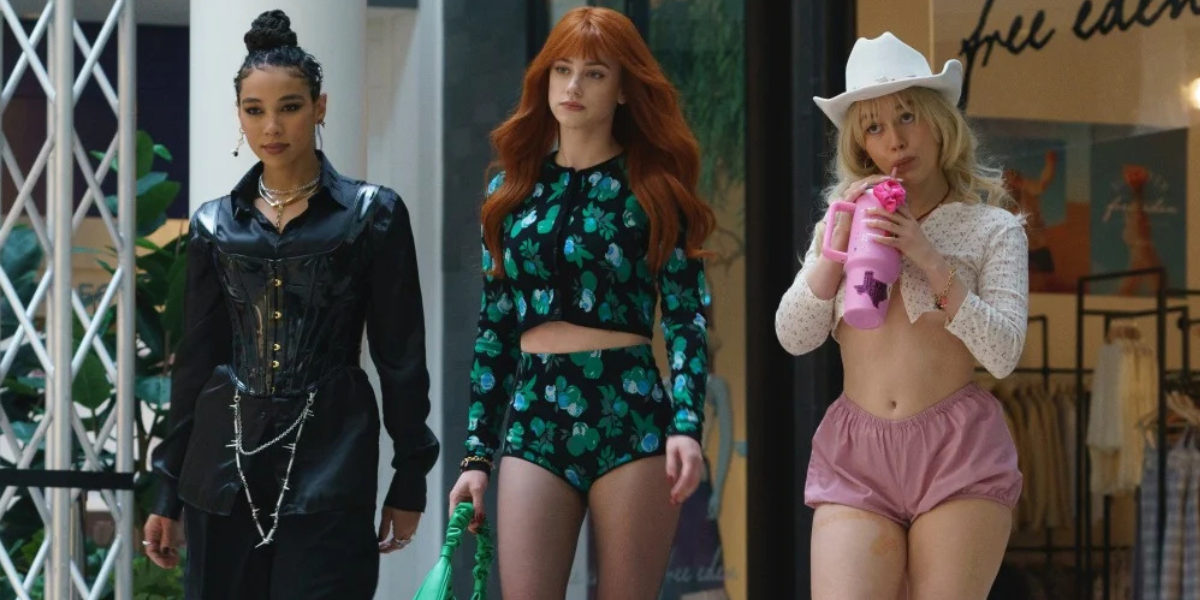
From the very moment it kicks off, Forbidden Fruits feels like a throwback to a bygone era of cunty girl cinema. Meredith Alloway’s debut feature — adapted from Lily Houghton’s play Of the woman came the beginning of sin and through her we all die and produced by none other than Diablo Cody — has a deceptively simple premise: A young woman joins a stunning group of mall retail workers and tries to navigate their performative sisterhood. And, well, who among us hasn’t been seduced by the allure of a cool-looking gaggle of gals?
It’s the kind of premise we’ve all seen (and loved) a million times, from Heathers and Jawbreaker to The Craft and Mean Girls (and all the way back to Cukor’s masterful The Women), but ideally sculpted for a contemporary audience. The girls of Forbidden Fruits embody their roles beautifully, each one playing into an existing archetype exactly as those who paved the way once did, but with their own personalities making them pop anew. Plus, they’re all named after fruits.
Pumpkin, the new girl in town played by The Summer I Turned Pretty’s Lola Tung, is less a naive newbie and more an investigative interloper, her eyes always scanning for cracks in the facade and ways to become essential to the group (and perhaps more…). Fig is the seemingly self-sufficient one of the bunch, with Alexandra Shipp playfully leaning into nerdiness beneath the facade of flawless coolness as she cites state birds and their qualities or talks about how much she’s attracted to Norman Bates. Then there’s the exquisite Victoria Pedretti as Cherry, the closest thing to a bimbo the film features, as deeply tragic as she is immensely funny, and practically a mirror of the woman they all idolize and admire: Marilyn Monroe. Every pack needs a leader, and that’s Apple, played by an oddly intoxicating Lili Reinhart in a role that can only be described as her “dark Betty mode” from Riverdale taken to another level. She’s curt and controlling, but she’s also just cunt, and maybe that’s exactly why the girls are willing to do pretty much anything to maintain the peace.
To reveal more about the details of how the film unfolds would be a bit of a shame, though suffice to say the cracks in the sisterhood are consistently challenged and exploited, leading to all kinds of hijinks and disaster. It gets messy, which can be considered as much a compliment as an insult to the way certain things play out. But what’s a movie about young women who have no lives outside of the massive walls of a shopping mall going to be if not that?
With all that established, I want to say something important: I love watching women be mean to each other. It’s something I grew up with, watching films like Heathers, Jawbreaker, and Mean Girls, and that has become a steady part of my contemporary viewing diet with half a dozen Real Housewives franchises. In recent years, this kind of trend has died out in cinema, with even something like the recent musical film version of Mean Girls — itself an adaptation of a stage play that is itself an adaptation of a movie — completely dulling down the kind of bite that made the original film so special. This isn’t necessarily a “new” thing, as a shaving down of edges has always been happening, but it feels all the more obvious in a world defined by cruelty (so, y’know, it’s all the more clear post-2016).
There’s been a distinct lack of cuntiness in contemporary cinema and television. I mean this in the good old fashioned “she’s being such a cunt” way and not a “okay she’s serving cunt” way. Cuntiness is something genderless, too, in this case, though it still hews toward the queer and feminine. Look at the way the Heathers reboot was unfairly maligned for fixating on how queer people can and do tear each other to shreds on a regular basis in order to get ahead. That kind of energy is what Forbidden Fruits is willing to bring back and what makes it stand out amidst so much current programming that feels lifeless and dull.
Diablo Cody’s name being on this project is a blessing of sorts, a nod toward the way her movies weren’t afraid to have women being awful (to themselves and each other), from the queer classic Jennifer’s Body to the mean masterpiece that is Young Adult. Forbidden Fruits comes with as much punchy dialogue as Juno, sure, but it’s all dedicated to dissecting the completely inane ways we pretend to connect with other people as a means of avoiding the loneliness of life (which is exactly what Cody has done her whole career). On this level specifically, Houghton’s script is exquisite, as keyed into the absurdity of communication (like only texting people you want to fuck via emoji) and capitalism (trying to scam a mommy blogger into buying a tablecloth for hundreds of dollars) as it is the ways that women can punish each other for not being exactly the kind of friend we want. That the film was once a play makes sense in some ways, though it’s hard not to wonder how some of its more cinematic and horror-based elements existed on stage, if at all (and I am also desperate to know more about another play of hers about a “Hitchcock-obsessed ex-Real Housewife”).
And boy are the women of Forbidden Fruits so deliciously monstrous to each other, while also occasionally giving a glimpse into just how sincerely kind they could be if not for the fact that they have to adhere to the rules set before them by their queen bee. It is frankly a delight to watch all of these actresses trading glares and barbs while accompanied by a banger of a soundtrack, or stringing together nonsense words as a mode of prayer or curse as they pour blood and tears into a gaudy boot. It’s all kind of stupid, and the witchcraft itself is kind of ancillary and potentially pointless, but that’s exactly why it works: The real power exists within the gals themselves.
Good writing alone is not enough though, so it’s refreshing to say Meredith Alloway brings this all to life with a real sense of style. Though this serves as her feature debut, the skill with which she directed numerous shorts — like the deliciously erotic Deep Tissue and the bite-sized toxic lesbian horror First Date — is fully on display here. She’s got a hell of a rhythm to the comedy and is able to make you gasp (with glee or disgust) at some truly ridiculous and riotous instances of horror. Even on an atmospheric level, Alloway’s film feels reminiscent of the odd worlds of Peter Strickland, perhaps most notably his own piece of commodification cinema, In Fabric. To limit it to aesthetic design would be foolish, as both films are ultimately borrowing from two different eras and countries for their capitalist monstrosity, but it’s all about the way people move within these weird spaces.
The domain of free eden — the film’s staple boho chic storefront that is clearly a play on Free People — and the deliberate performances of the women within it feel of a piece with how Strickland’s entrancing department store functions in his feature. In no way is Lili Reinhart on the level of Fatma Mohamed (whose work in Strickland’s The Duke of Burgundy is arguably the greatest scene-stealing in lesbian cinema), but she weaponizes a dead-eyed gaze of control from a saleswoman in a very similar manner. It’s all about the little gestures, the offbeat reactions, and the subtle sensuality behind the way she presents her own ideas as something truly good for you. Plus, she’s even trying to create a utopic world for herself and the women around her! Who could blame her for trying?
Well, everyone can. And that loathing, envy, manipulation, and tragedy is what drives Forbidden Fruits. Perhaps it isn’t nearly as tight as it could be, sort of sprawling in all directions after it has run out of incisive criticism, or even as queer as it could (and maybe should) be, with its sole instance of girl-on-girl being one of shock and power, but maybe that’s okay, too. Maybe the fact that we’ve been given a movie about thoroughly messy women is enough, even if the package is itself a little messy. If Alloway and Houghton are given the chance, Forbidden Fruits is also the kind of movie that could spawn a ludicrous universe and further exploration — and, honestly, I’d be thrilled to get to spend even a minute more with some of these awful wonderful women.
Forbidden Fruits will have a limited theatrical run and drop on Shudder starting March 27.


Comments
I’m so glad the local theater near me had an early screening of it. I had a wonderful time! Been telling people it’s like a modern The Craft set at a mall. Only critique is it could’ve been queerer lol.
agree 100% i felt pretty misled. lovedd the first 5 mins when i *thought* it was gonna be gay as hell :’-) rip
It is so refreshing to see the resurgence of that specific, sharp flavor of mean girl cinema, especially when it is done with a bit of self-awareness and style. There is something endlessly entertaining about watching highly stylized, complicated female dynamics play out on screen when the writing actually hits the mark instead of just relying on old, tired tropes. It completely captures that nostalgic, messy energy that made classic teen dramas so addictive to watch in the first place.
Do you think this current wave is going to stick around and evolve into a deeper subgenre, or is it just a fleeting trend capitalizing on our collective obsession with late 90s and early 2000s aesthetics? It feels like audiences are definitely craving more of these campy, sharp-edged stories right now.