





I killed a two-year online friendship at the start of 2026. I made contact with a fellow online sex worker in 2024, and we struck up a friendship over mutual complaints about clients, the economy, and life in general. Our friendship was further smoothed by a light and mutual sexual interest. We sexted and exchanged plenty of nudes. We checked in on each other’s well-being in this competitive and stigmatized profession. I was incredibly happy to just have a close sex worker friend, a person I could go to for discussions on the finer points of the industry.
Based on the headline, I think you know where this is going.
I’m surely not the only person who’s grown tired of the burden of vigilance on social media. I’m vigilant about targeted advertising, undisclosed advertising, misinformation, AI, AI misinformation, stalkers, creepers, catfishers… the list goes on. I think of myself as media literate, but existing online is an eternal battle with privacy, attention, and confidence at stake. Users must resist constantly, but a bad actor only needs to slip through once to cause harm.
My friendship with Rain (a handle the catfisher used) started even though I was hardened to the schemes cooked up by businesses and organizations to sell me something. Rain had a long-running, active Instagram account of the sort an independent sex worker would have. I found ‘her’ convincing because there were no immediate monetary or sexual overtones in her messaging. In fact, I was the person who opened up the possibility of sexting and more personal conversations. Whenever she was private or reticent about her work, I chalked it up to a boundary related to privacy and the sex work taboo.
The person I affectionately termed Miss Rain found a foothold in my life because she didn’t match my mental profile of an online threat. She declined my offers to pay for lunch on particularly difficult days. We checked in on each other semi-regularly and kept each other updated on happenings in life. I regularly vented about the difficulties inherent to online sex work. My caution dissolved as our friendship settled into place.
“Some reasons people may catfish others without a monetary incentive include loneliness, entertainment, and an inferiority complex,” says author, activist, and PR specialist Dylan Thomas Cotter when I speak with him about catfishing. This can be especially true when “they are attracted to this person and know for a fact that the person they are catfishing would not be into them for a variety of reasons,” Dylan continues.
Dylan’s suggestions resonated when I re-read the final messages I had with Rain.
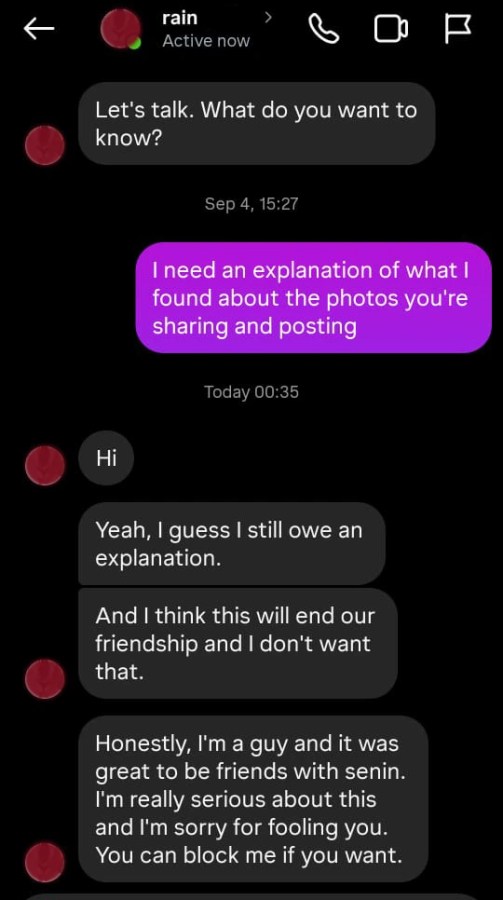
Even when I opened the possibility of sending a bit of cash for lunch as friends do, I was gently turned down. I initiated the flirtation and light sexting. Rain only ever asked for my company and conversation. The final admission that ‘Rain’ was ‘a guy’ who wanted to be friends with someone actually reads true for me. It makes the whole thing sadder.
Despite our enjoyable conversations, I also had nagging suspicions. The photos posted on Rain’s account showed a variety of AirBnB and hotel settings. This seemed at odds with his story of being in dire financial straits because shooting in rented environments is usually done by established online sex workers. I’d know, because I’m a small creator who can’t afford nice scenery. This suspicion stuck with me, and the detective-minded side of me wanted to know more.
You see, when I was a teen, sex predators tried and failed to groom me online (a story for another day). I’ve been targeted by predators, and I approach most of my online interactions cautiously. With my worries adding up, I turned to one of my favorite tools: reverse image search.
I collected some of Rain’s images, both from the public account and nudes sent to me in private. I ran them into a few reverse image search tools, and the hits came swiftly.
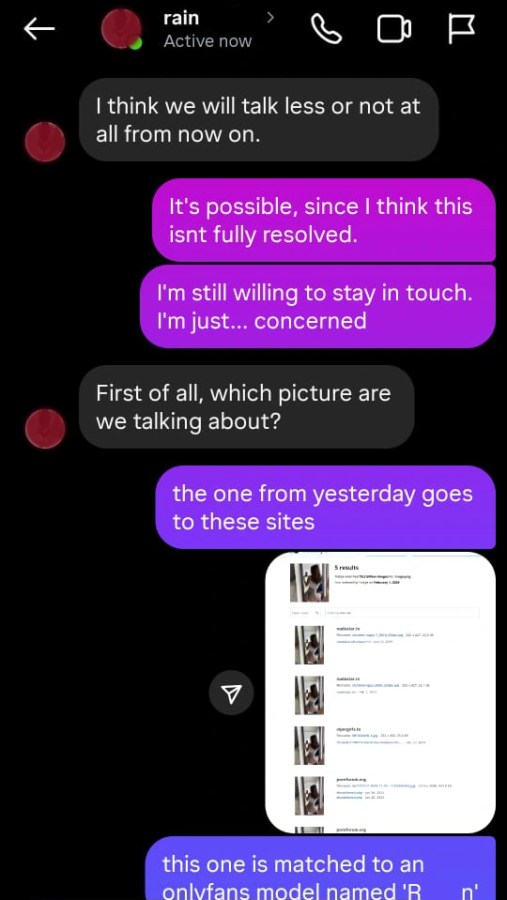
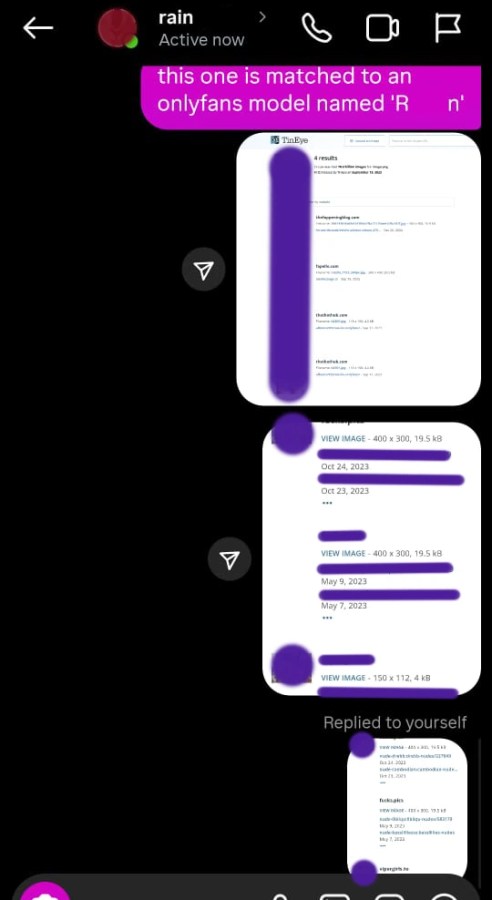
The images were traced back to multiple creators whose content was posted to multiple leak sites. There exists a cottage economy of people who subscribe to online sex workers, mass-download their content, and reupload it on sites dedicated to leaking said content. This gives bad actors free access to otherwise private content and is a form of digital piracy mostly targeting online sex workers. I traced most of Rain’s photos to these sites. He had taken care to use photos of creators who had a similar build and aesthetic so that there were no obvious differences between pictures.
My almost paranoid knowledge of data privacy led me to reverse image searching. Dylan recommends it to those who are suspicious. “Grab a photo or two from the person’s account with whom you are conversing and conduct a Google reverse image search of the photo(s) and see what you find,” Dylan advised. “You may learn a lot or nothing at all. It’s like a low lift background visual check to help surmise if, in fact, this person is who they say that they are or not.”
Getting a hit using reverse image search (such as TinEye) that contradicts someone’s narrative is a sure sign something is amiss. There are very few legitimate reasons for someone to misrepresent themselves online. Running a reverse image search on your photos can also turn up interesting results. You may find that your social media privacy settings aren’t as tight as you think or that some of your images have been reshared without your knowledge.
Reverse image search used to be much more effective, but improvements in generative AI have made it much easier to create convincingly fake photos of people. This Person Does Not Exist uses machine learning to generate an endless stream of realistic images. These images are used in cybercrimes (spambots, catfishing, fraud) but are also used for research in many fields.
Attorney Jeffrey Nadrich notes: “There no longer needs to be another real person on the other end of the screen. People can hide behind fake, AI-generated images and build trust with a user with the click of a button.”
Media literacy can be summed up by the Russian proverb trust, but verify. Existing in a state of total paranoia and mistrust is both tiresome and can develop blind spots that can be exploited by fear- and paranoia-based misinformation. Conversely, it would be incredibly naïve to believe everything that’s posted online. Trust, but verify is the middle ground that makes it possible to use social media and stay vigilant.
Unfortunately, I broke my own rule and trusted too much.
My first suspicions toward Rain involved his Instagram account. It posted crisp, flirtatious semi-nude photos on a monthly basis in a manner akin to OnlyFans creators on PG-13 sites. Unusually, there were no offsite links to pages where a client might find the proverbial ‘good stuff’. People trying to sell something generally make it easy to find them.
When I asked Rain about it, he told me that he only sold privately in messages because OnlyFans was banned in his place of residence: Turkey. The story checked out. I also let go of this suspicion because there are plenty of people who post risque photos on social media for gratification. I’m one of them. Like I said earlier: Vigilance requires eternal effort on the target’s part, but a bad actor only needs to succeed once to penetrate people’s defenses.
According to Dylan, users can make online verification work for them. He says that, “a general sign of verification on platforms is helpful in displaying that a corporation has already verified the authenticity of the person(s) in question.”
Online identity verification policies have exploded in popularity in the last few years and are rightly criticized for their privacy and data safety risks. ID verification used to be the domain of porn paysites wishing to keep minors (and the ensuing lawsuits) out. One silver lining of this rollout is that if you are on a site where age verification is the norm, you can have slightly more confidence in your interactions. Anyone who is still misleading you on such a site would be committing identity fraud and using more sophisticated techniques to fool third-party age and ID verification. Even something like Tinder’s Photo Verified checkmark requires finding someone who resembles the person in the profile and posing them convincingly to fool the verification process.
Verification comes in other forms too. As the connection develops, people will divulge other socials, work, and relations. A quick search against these claims is usually sufficient. You don’t have to resort to background checks to meet the bar for due diligence. Maintaining a network of lies is difficult for all but highly dedicated fraudsters. Catfishing and similar abuse thrive in environments of data isolation: The more cut off the victim is from external data, the easier it is for a bad actor to uphold their lie.
Although AI voice cloning is possible, it hasn’t reached a stage of accessibility that allows anyone to do it. Setting up an audio call introduces friction into the lives of anyone trying to mislead you: To continue their ruse, they must have the tools to falsify a voice or give a litany of excuses for why it’s impossible. The same applies to a video call, which takes this a step further. It’s an imperfect tool, but our eyes and ears are well-attuned to details in people’s mannerisms and communication.
“There’s only so much people can hide about their identity verbally,” Dylan says. “You learn a lot about authenticity based upon the tone and register that people speak in that can not be told immediately through text communications alone. If a person hesitates to verbally connect with you for any reason, chances are they are hiding something and do not have honorable intentions.”
Jeffrey suggests a similar technique for spotting deepfaked video: “As it stands, you can still ask for a spontaneous video call with the individual you’re chatting with to see if they are who they say they are. If you can get on video with them, request they do something unexpected like wave a specific hand or hold up a random object. Since deepfakes struggle with spontaneous physical requests, this could help prove their identity.”
During my time with Rain, we never once had a voice or video call. I don’t favor either type of communication, so I just assumed Rain was the same. It never occurred to me that a one-year online friendship without any calls would be unusual. I wonder if I would have spotted inconsistencies in his story sooner if I tried to set up a call.
I confronted Rain about his betrayal of trust because the lack of a financial motive suggested that I was talking to someone seeking a social connection. I was especially hurt when I realized our year-long friendship was fraudulent. Truthfully, I was just experiencing the very normal desire of needing the truth.
Once I had enough evidence that Rain was misusing online sex workers’ images in his profile, I opened up the conversation. My discovery of the lie destroyed any love I had for our friendship. This was a good mindset for the circumstances, because accusing someone of this can’t be undone.
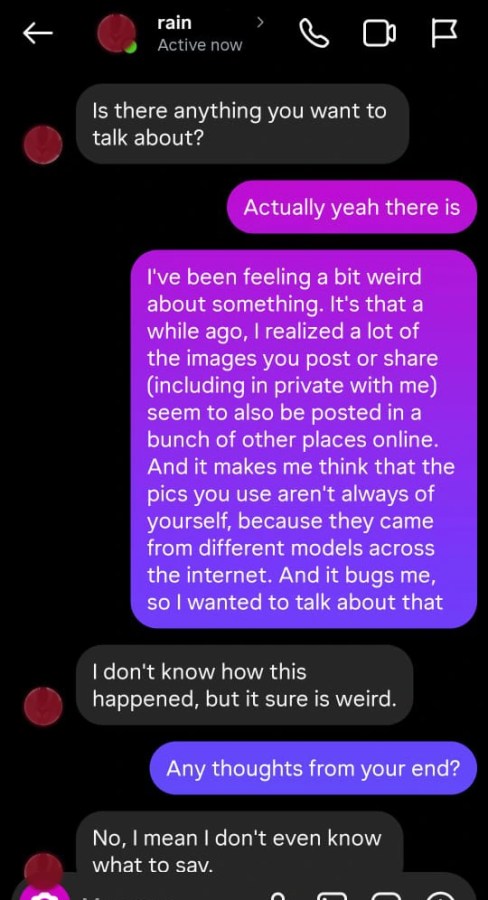
Rain denied wrongdoing and had no excuses for the evidence I presented. I confess to feeling smug about how off-guard he was left by my detective work. A part of me did want him to feel shock and distress for what I’d been through.

We had a back-and-forth over the evidence before he eventually confessed that he’s a man and this had all been an act. His final message to me was, “Honestly, I’m a guy and it was great to be friends with senin [sic]. I’m really serious about this and I’m sorry for fooling you. You can block me if you want.”
I obliged him on the block and got on with my life, albeit one friendship short.
Unsurprisingly, this whole experience has left me with a sour taste in my mouth. It happened months ago, and I’m still thinking about it. Women, but specifically those of us who are sex workers, live in constant fear of deception perpetrated by men. Deception is bad for anyone who suffers it, but it’s often a prelude to future abuse. Our friendship wasn’t the sole casualty of this deception. He received lots of intimate media from me — media I only consented to sending because I was under the impression that he was someone else. This is the first time I’ve sent intimate media to someone and then learned it was blatantly misused. That’s another notch on the list of sexual violations I’ve experienced.
I’m getting better, though. I lost a friendship, some trust, and my homemade porn is out there (it already was). My wallet was blissfully unblemished after this, and I’ve learned a lot about online impersonation and how to protect myself in future.
Just as I try not to blame myself for my sexual victimization, I’m also trying to stave off self-blame for this incident. My biting internal monologue sometimes blames me for not vetting the person out better before sending nudes and video, but I know that needs to be resisted. If you experience this in your lifetime, remember that you didn’t fail to protect yourself or investigate enough. The shame of deception should stay with the deceiver.
Catfishing is here to stay. It’s a digitized version of one of humanity’s oldest behaviors: lying. Even though it feels like we’re being assailed by technologies designed to betray us, the less newsworthy fact is that there are always tools to resist. Some protective measures will become obsolete, but we’ll have new ones for the rapidly changing future.
Online safety used to preach the necessity of not talking to strangers online, meeting them in person, or getting into their cars. I have an app installed solely to contact online strangers, meet them, and get into their cars for trips around the city. I don’t feel any more or less safe online now than I did as a child. Vigilance will always matter, but the shape changes every year.


Comments
This sucks. I’m sorry you experienced this betrayal and lost a friendship built on fake foundations. As you’ve said eloquently in your article, it wasn’t your fault, and it’s sad and disappointing that “Rain” chose to lie.
That’s awful and sucks! It’s good you’re not financially out of pocket, but the fact it was just friendship makes it more sad, in a way.
damn i am really sorry that happened to you summer. thank you for sharing
I was so confused by the headline. I read it as “I sent nudes to someone [and I was] pretending to be a sex worker” and I did not have any idea where this was going 😅🙈