Teens do not fare well in slashers. They are punished by a boogeyman, a killer, sometimes masked and sometimes not. They are punished for their sins, their impulses, their carnal desires, their stupidity. Nightmare on Elm Street breaks this pattern. Teens die, yes, loads of them throughout the franchise. But it’s not as a direct result of their own choices.
Teens in other slashers act like teens and then get what some adults in their lives might say they had coming. Teens in Nightmare on Elm Street act like teens and then are killed not because of what they are doing but because of what their parents did. Freddy Krueger was forged by the flames of vigilante justice, and now he’s back for vengeance against the descendents of his executioners.
The parents know what they did, and still, they do not believe their children when they come to them about their nightmares of Freddy. He’s dead, buried, and these adults believe violence really can just be cordoned off into the past without echoing into the present.
The teens aren’t the fools; their parents are.
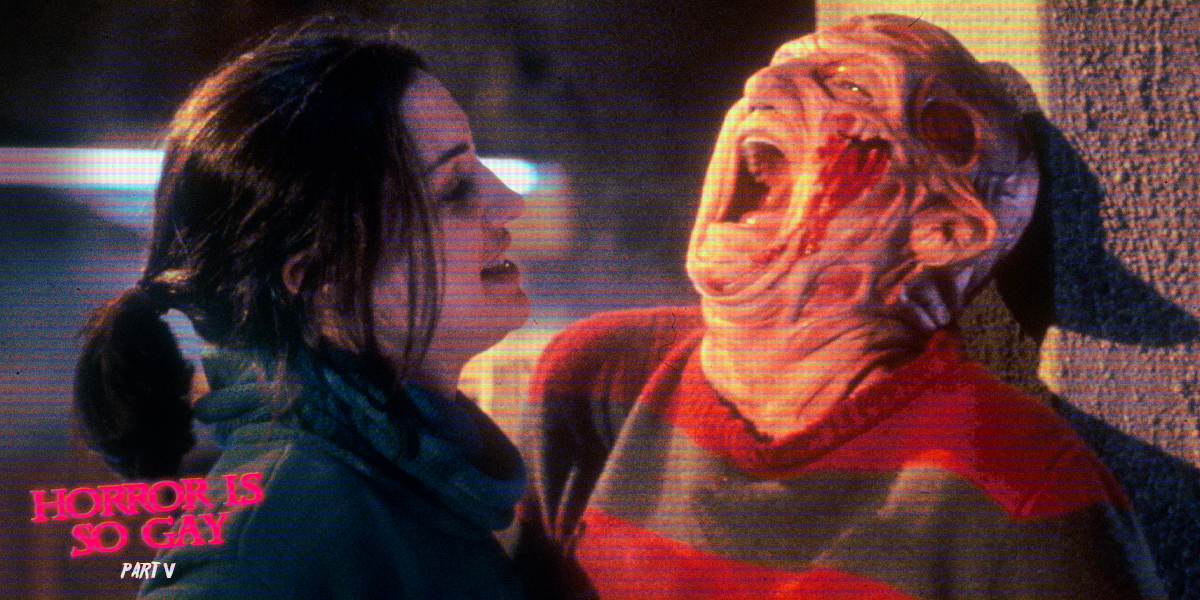
I did not expect Nightmare on Elm Street to usurp Scream as my favorite horror franchise when I initially embarked on a project with my friend Drew to rank all the movies in (almost) every major slasher franchise. But it happened, and it specifically happened when I watched Freddy’s Dead: The Final Nightmare, easily one of the most underrated horror movies of all time.
Every slasher franchise has some stinkers in it, but Nightmare genuinely doesn’t. Even its weakest films stand far above the most nonsensical sequels in other horror franchises. And then to have a sixth film stand out so much in the way Freddy’s Dead does is especially unexpected. After watching it for the first time, I watched it almost immediately again. A week later, I bought the DVD. I only become that immediately obsessive with movies I know I’m going to write about, movies whose impact on me I want to analyze. What makes Freddy’s Dead so gripping, haunting, pressing? Follow me into the nightmare as I try to make sense of it.
Freddy’s Dead is the first and only Nightmare movie to be directed by a woman (Rachel Talalay) and the only film directed by a woman across any of the major franchises Drew and I watched for our project (Halloween, Scream, Friday the 13th, Texas Chainsaw Massacre, and Chucky). One out of 58 films. This isn’t surprising to anyone with even a cursory knowledge of horror film history, but it’s a striking fact nonetheless.
Talalay’s approach to Freddy’s Dead, working from a screenplay by Michael De Luca, isn’t to reimagine or reinvent but to double down on the world’s most potent themes. The themes that have always called to me, the ones that signal this franchise as different. The initial setup of the film alone is immediately chilling, announced in text at the top of the film: Every child in Springwood, the town long terrorized by Freddy Krueger has died, by murder or by suicide. It is a place without children.
The last teen of Springwood, John Doe, makes it out, but he suffers from extreme amnesia that has erased all memories of his home, his family, and his tormenter Freddy. He ends up at a shelter for troubled youth, where he’s placed under the care of Dr. Maggie Burroughs, who becomes convinced the only way for John to heal is to bring him back to the place he was running away from. The two head to Springwood, three other teens from the shelter in tow: Spencer, Carlos, and Tracy, more “troubled teens.”
The language of “troubled youth” is often wielded as a weapon (a horror Netflix’s Wayward portrays incredibly well) against young people, under the guise of helping them. To call a teen “troubled” is to suggest it is in their nature, never nurtured by outside forces. Freddy’s Dead understands the failures and fallacies of this approach to labeling and condemning children. The teens of Freddy’s Dead are not “troubled” because of their own choices and actions but because of their parents’. The system considers rich boy stoner Spencer a problem for his drug use, but really he’s just trying to escape the expectations of his father to behave the way his father thinks a boy of his class status should behave (to the suggestion he be more like his dad, Spencer says: “I don’t feel like playing football and date-raping coeds”). Carlos comes to the shelter partially deaf as a direct result of his mother’s physical abuse, and Tracy, a survivor of sexual abuse by her father, spends much of her time in the shelter learning to fight. These teens are only “troubled” because their parents made them so.
Parental abuse and neglect takes many forms throughout the Nightmare franchise, sometimes overt, sometimes subtler. Freddy’s Dead needles into the totalizing impact of this abuse. The nightmare sequences start with the parents as tormentors before Freddy steps in. Freddy heightens and distorts the fears these teens already feel deep in their bodies.
Cycles of familial abuse power the entirety of Freddy’s Dead‘s story, including an expanded and slightly revised origin story for Freddy himself to show more of the abuse he experienced. Though it likely wasn’t intentional, the film’s subtitle is ironic and poignant: The Final Nightmare. There would be three more movies after this one, including a reboot. Nightmare didn’t end, and the nightmares Freddy’s Dead contends with will never really end either. There’s recurrence to the trauma, violence, and abuse. The repetitions in Nightmare movies slice deeper than the mechanical plot device of Jason and Michael always coming back from the dead, or someone new picking up the Ghostface mask.
I was late to Freddy’s Dead, but it couldn’t have come at a more horrifying time. I watched this film against the backdrop of book bans, sports bans, anti-trans classroom policies, and the gutting of public education. In other words, I watched this film, very much about harming children, against the backdrop of some of the most coordinated attacks on youth in this country. Conservative interest groups are fighting boogeymen in classrooms around the country in the name of Parental Rights. Throughout school districts in the country, the concept of ‘Parental Rights’ have been used to argue against trans-affirming policies and for censorship—both in the books kids have personal access to and in the materials educators are allowed to teach and discuss. Moms For Liberty members hurl obscene strawman arguments at school board meetings (oh, so you think children should have access to PORNOGRAPHY?) to defend the implementation of these policies.
They’re creating a nightmare for their children and other children in their communities, especially queer and trans and otherwise marginalized youth. While the Freddy’s Dead parents are more overtly nefarious, even parents in previous Nightmare installments ignore their actual children’s needs and wants in favor of their own personal opinions about what’s best for their children, telling themselves they’re doing the “right” thing. One of the franchise’s most memorable set of lines comes two movies before Freddy’s Dead, in Nightmare on Elm Street 4: The Dream Master, in an argument between Kristen, the protagonist of the previous film, and her mother. She accuses her mother and her mother’s “tennis pals” of killing and burning Freddy, who is now torturing her and her friends for revenge.
“Kristen, we went over this in therapy!” her mother says.
Kristen, in response: “No mother, you just murdered me. Take that to your goddamn therapy.”
Again, parental harm takes all different shapes and forms in the Nightmare movies. Kristen’s mom likely would consider herself and her tennis pals to be leagues away from the more overtly monstrous parents in Freddy’s Dead, but her neglect, denial, and manipulation of her daughter (who she drugs with sleeping pills, thinking she’s “helping” with Kristen’s insomnia) indeed lead to her death.
Other slashers gleefully kill their young. Nightmare films have a ton of empathy for Freddy’s teen victims. And it’s that weight to the character storytelling that also allows the films to go full camp and embrace goofiness without going off the rails. Freddy loves a one-liner, and the nightmare sequences are often a funhouse mix of horror and humor, as with Spencer’s nightmare taking the form of an arcade game to which Freddy holds the controller, making Spencer jump up and down with a boingy sound effect like he’s Mario. But the silliness is grounded, too, and scary.
Plenty of scary movies portray the horrors of being a teen, but few manage to actually be about that with the same urgency and directness as Nightmare movies do. Freddy’s Dead reveals the actual end goal of stripping young people of agency and freedom: no young people at all. In the case of Springwood, that’s very literal, and in our reality, that looks like turning young people into uneducated, soulless pawns of the state.
In Freddy’s Dead, Tracy, Carlos, and Spencer try to get out of Springwood, but they can’t find a way out, returning over and over again to a statue of a boy scout—or a boy soldier—standing above the words “THE CHILDREN SHALL ENDURE.” Springwood still has a school, but it’s devoid of children and frozen in time. In a harrowing and eerily prescient scene, a teacher gives a lecture on the timeline of Freddy Krueger’s horrors to an empty classroom. His lecture doesn’t address how Freddy died, how a group of parents banded together to kill him, effectively damning their own offspring and whole generations of this town. This is the fantasy conservatives want: an empty classroom, a society stripped of public education, where history is selective and where fear governs and controls the choices young people can make.
These are the exact horrors that haunt me when I think of my friends’ children, children in my community who I don’t even know, the children I cannot make up my mind about having, the conversations I’ve had with my educator friends about the catastrophic literacy crisis caused not merely by this Administration but also detachment and negligence from parents. You are as foolish as the characters in a slasher running toward danger if you think none of this will affect you just because you don’t have children of your own. The actions of the parents at the beginning of Nightmare’s timeline have consequences that ripple for generations in their community and go far beyond the threat of Freddy Krueger. Book bans, “don’t say gay”-style legislation, and surveillance-style policies for trans students all amount to an overall attempt to control and suppress young people, and too often the manipulative language of “parental rights” obscures parental harm and its lasting effects.
Freddy’s Dead came out in 1991. Just two years prior, the United Nations established the Convention on the Rights of the Child, a treaty based on the radical notion that children (which it defines as anyone under 18) are people, not just objects owned by their parents. After Somalia ratified the treaty in 2015, there is only one member country of the UN left who has yet to do so: the United States. Conservative groups and leaders have long led opposition to the treaty, which grants children rights of their own. To be clear, ratification of the Convention on the Rights of the Child alone does not tell the whole story of a country’s treatment of children—Israel, for example, maintains its ratification of the treaty does not pertain to its treatment of children in Gaza and the West Bank—but the U.S. refusing to meet even the bare minimum of ratification is appalling and speaks to just how deeply conservative values regarding family and parenting are embedded in this country. Book bans are about much more than books. Classroom policies have repercussions that reverberate beyond a school’s walls.
I’ve watched over forty slashers in the past three weeks, and almost all of them are, at their surface, about young people under attack. But it’s the Nightmare films and Freddy’s Dead in particular that most accurately reflect the realities of attacks on youth and just how pervasive the denial of children’s agency is in American society, the razor-sharp finger blades of conservative family values puncturing wherever they can, like Freddy searching for new hunting grounds after stripping Springwood of its children. As he taunts in the final act of Freddy’s Dead: “Every town has an Elm Street.”
This essay is part of Horror Is So Gay: Part V, our fifth annual series on queer and trans horror.