About Me
| About Me |
The first thing Bangkok does is lie to you through your phone. You open the map, you see your hotel and the place you want to eat, and the gap looks like nothing. A finger’s width. Twenty minutes, tops. Then you step out of the lobby into 34 degrees with humidity that sits on you like a wet coat, and you find out the twenty minutes is closer to fifty, that the pavement gives out halfway and turns into broken tile behind a row of parked motorbikes, and that the street on the map is actually a soi running two kilometres inland off a six-lane road you cannot cross.
I have watched people quietly give up on Bangkok in the first thirty-six hours because of this, and it is almost never about the city being difficult or frightening. Bangkok in daylight is one of the easier huge cities to move around on your own. What gets people is the friction. It is standing on a corner at two in the afternoon watching a car that is nine minutes away become fourteen minutes away and then nine again. It is the small grinding loss of control over your own day.
That is the problem worth solving before you go.
The train lines cover less than you think The BTS Skytrain and the MRT are genuinely good. Air conditioned, cheap, punctual, and lifted clear above the traffic everything else is sitting in. If your trip is Siam, Asok, Thonglor and Chatuchak market on a Saturday, you will barely think about transport at all.
The catch is what happens once you come down the stairs. Bangkok addresses hang off long side streets, and a soi can run a very long way back from the main road. On Sukhumvit the odd numbers run up one side and the even numbers up the other, and the far end of any of them is a serious walk in that heat. The station gets you to the mouth of the street. It does not get you to the door.
Then there is everything the lines do not reach. The old town is on the MRT now and the riverside has the boats, but a lot of the city worth your time sits in the gaps. The Thonburi side. The residential pockets north of the centre. The restaurant somebody swore by that turns out to be forty minutes from any station in any direction.
The boats are the most underrated thing in Bangkok. The orange flag express boat up the Chao Phraya is fast, cheap, and the view is most of the point. The canal boats along Khlong Saen Saep are faster again and chaotic in a way people either love or never repeat. You step on while it is still moving. Everyone ducks at the same moment under the low bridges.
Grab, motorbike taxis and giving up control Grab is the default and it works, so I am not going to tell you to avoid it. Book a car, get in, arrive. It is priced through the app, so the haggling that used to come with a taxi is gone.
What you are buying, though, is a car in Bangkok traffic. Between roughly four and seven in the evening, and any time it rains properly, the app quotes you a number and the number turns out to be fiction, and there is nothing you can do from the back seat except watch. I have sat in a stationary Grab for thirty-five minutes covering a distance I would have walked in twenty-five, if walking it had been bearable.
Motorbike taxis fix the traffic and cost you something else. The drivers in the numbered orange vests wait at the mouth of almost every soi, they know their patch better than any app does, and they will thread gaps a car cannot. For that last kilometre between a BTS station and your door they are the right answer.
The trade is that you are on the back of someone else’s bike. You do not set the pace, you do not choose the line, and you do not decide when to stop. Plenty of people are fine with that. Others find it is the most stressful ninety seconds of their week. Ask for a helmet. Some drivers carry a spare and some do not, and it is worth walking to the next one if the answer is no.
Riding yourself: who it suits and who it does not Which brings us to the option most travel writing either skips or oversells. Renting your own scooter changes the shape of a Bangkok trip more than any other single decision. You stop planning around where the trains happen to go. You leave when you want, you stop when you see something, and the city stops being a set of destinations joined together by waiting.
Now the honest part. Bangkok traffic is dense, quick in the gaps and stationary everywhere else, and riding in it is a real skill. Lane discipline is loose. Bikes filter constantly. In the wet season the rain arrives with very little warning and the road goes slick in a way that punishes anyone who grabs a handful of brake. This is not a city to learn to ride in. If you have never been on a scooter, a week in Bangkok is not the moment to start.
If you have ridden before, even a bit, it looks different. A 110cc or 125cc automatic is light and twist-and-go, and city speeds are low. Do a few quiet sois early in the morning before you take on a main road. Wear a helmet every single time, including the two-minute run for coffee. Cover your skin even though it is hot, because the tarmac is not interested in how hot it is.
One thing to be clear about: city rental bikes stay in the city. Bangkok shops restrict their bikes to the metropolitan area and it is written into the agreement you sign, so the daydream of riding off down the coast is not what you are renting. Plan the bike for Bangkok and take a train or a van if you want to leave.
The practical checklist If you decide to ride, sort all of this before you land. Licence. You want a motorcycle entitlement on your home licence plus an International Driving Permit that covers motorcycles, sorted in your own country before you travel. You cannot get one once you have arrived. Riding outside the category you hold looks like a technicality right up until you need to make a claim.
Insurance. Check whether your travel policy excludes motorcycles, because a lot of them do by default, and some only cover you if you are properly licensed for what you are riding. Read the wording, not the summary page.
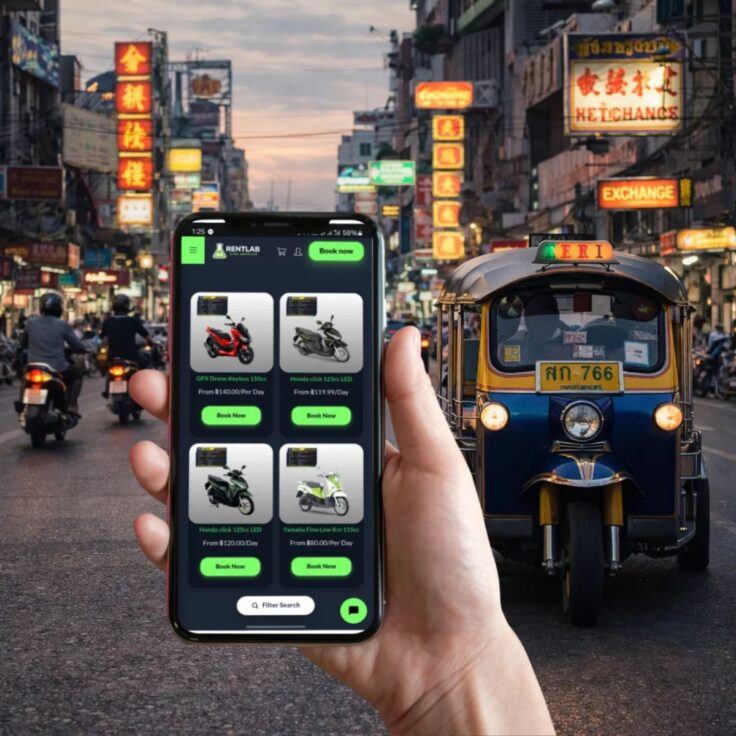
Helmet. Every trip, including the short ones. Any decent rental includes one. What the shop asks for. The old Bangkok model is a cash deposit plus your passport sitting in a drawer until you bring the bike back, and handing your passport to a shop you found on a street corner is a bad idea for reasons that have nothing to do with motorcycles. Newer operators have moved off it. rentlabth.com is one Bangkok example worth reading as a reference for what current terms look like: you book online, your identity is verified digitally instead of the passport being held, there is no deposit, you collect the bike yourself, a helmet comes with it, and a 125cc is listed at 230 baht a day on a two to six day booking, which is under ten dollars at recent rates. Whatever shop you use, get the terms in writing and photograph the bike from every angle before you ride away.
A day that works The version that holds together goes something like this. Morning on the bike while the roads are still moving, because Bangkok before nine is a different city and the light is better anyway. Park it around midday and take a boat along the river, when the heat makes anything exposed a bad idea and sitting on the water is the best thing on offer. Late afternoon, stay off the road and use the BTS, because that is the window when traffic wins and there is no point arguing with it.
Evening, back on the bike or on foot depending on what you have been drinking, and the answer to that one should be obvious.
The point is not that any single mode beats the others. It is that you get to pick, hour by hour, instead of taking whatever the city hands you.
Bangkok is not a hard city to be alone in. It is a hard city to be passive in. Every version of this that goes badly has the same shape: someone standing still in the heat, waiting on a decision that belongs to somebody else. Every version that goes well has you moving under your own steam, whether that is a train, a boat, or your own set of keys. Work out which one that is before you go. |