





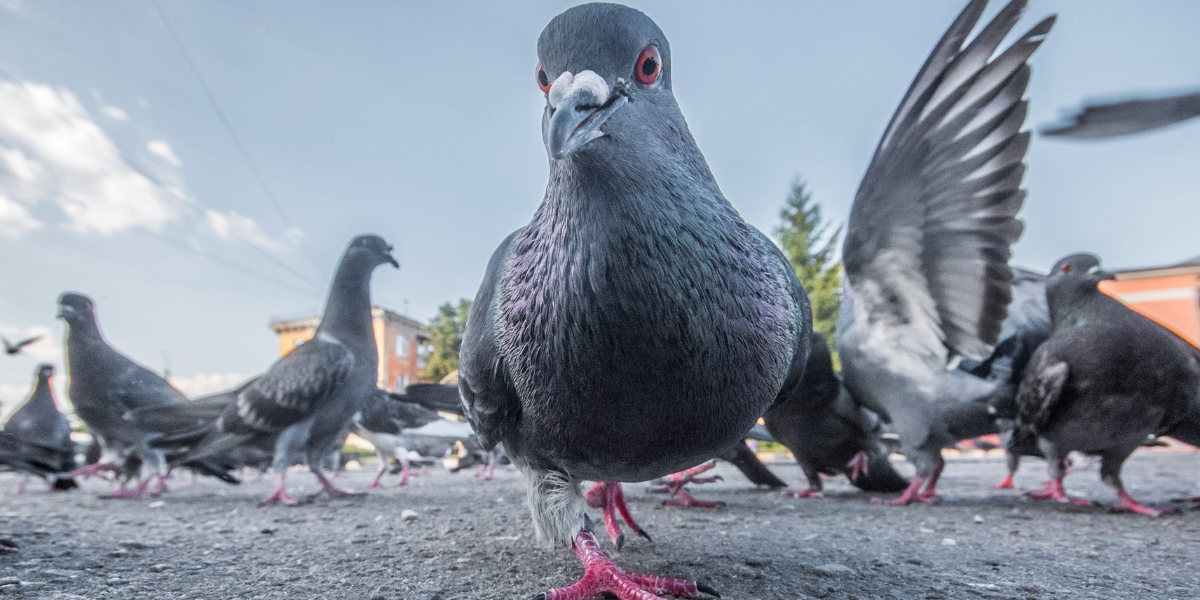
On a sunny Saturday morning in early April, some friends and I stand with a group of 20 other people on a corner in South Philadelphia, looking up through binoculars at a flock of pigeons roosting on the city’s power lines.
We’re on one of the city’s Philly Pigeon Tours, a 90 minute walking tour where we will learn all about pigeon behavior, biology, and history. Led by tour guides Aspen Simone and Hannah Michelle (HM) Brower, Philly Pigeon Tours offers a socially conscious look at “the pigeon layer”: the world of pigeons we mostly ignore, but that is intimately entwined with our own social and urban lives.
It turns out the pigeon layer is pretty gay. Pigeons have a lot to teach us about queerness, and we can better understand the social history of pigeons by using a queer lens.
HM and Aspen, who are both queer, had the idea to start Philly Pigeon Tours after adopting Primrose, a malnourished pigeon they found on the street. “We think of her only partly as a pet, and partly as an ambassador for the species,” Aspen and HM tell me.
By learning how to care for Primose, “we learned a lot about pigeon behavior and body language,” Aspen says. “Over time, I realized that pigeons tended to flock in the same few places in the neighborhood, and came up with the idea for a walking tour.” After their first tour was mentioned in The Philadelphia Inquirer, it quickly sold out. Now Aspen and HM run two tours per week, plus school groups and private tours.
As HM and Aspen guide us around the neighborhood, they share facts and information about pigeons, much of which complicates heternormative and cisnormative understandings of biology.
After pointing out a mating pair sitting on the power lines, Aspen demonstrates the pigeon mating dance (!), which can be performed by pigeons of any sex. “People tend to believe that when they see a pigeon doing a mating dance, circling and cooing and chasing another pigeon, it’s a male pigeon wooing a female pigeon. This isn’t based on good science,” they say. “It’s people — including birders and scientists — projecting a specific set of ideas about human gender roles onto pigeons.”
It’s not uncommon for pigeons to mate in same-sex pairs. If you’ve heard about Charm and Suki the lesbi-hens or if you followed the bisexual pigeon throuple drama that went viral last December, you’re already in the know.
And while pigeons are often thought to mate monogamously for life, the tour guides share this is not really the case. Some pigeons have multiple mates, switch mates, or leave one mate for another. HM and Aspen tell us Primrose recently broke up with her pigeon boyfriend — and watching her reject him was devastating!
“We’ve recently started studying sex and gender in pigeons and birds overall, and it gets way more complicated,” Aspen says. “Birds have a different set of chromosomes, hormones, and ways of producing sex characteristics.” Identifying the sex of a bird is much more complicated than just observing which bird of a pair is bigger, more colorful, or more “active” in the mating process.
Mammals are typically thought to be the only animals that nurse their young, but HM and Aspen share both male and female pigeons can produce “crop milk,” which is a substance they regurgitate to feed their chicks. This makes both male and female pigeons integral to the process of parenting.
“As a non-binary person, I resonate with a lot of the complication we find in bird gender,” Aspen says. “Growing up and even into adulthood, I would hear these dominant ideas about how men and women are supposed to be…I’ve learned, through a lot of personal experience, that the standard narratives don’t really fit real people.”
It turns out that the standard narratives don’t fit most animals either. The roles we project onto animals often tell us more about the norms and values of the human world than the realities of animal sex, gender, and biology.
HM and Aspen hope their tours help educate people about pigeons to shift the stigma surrounding them. For decades, pigeons have been known as “rats with wings.” But as most pigeon advocates and experts will tell you, this wasn’t always the case.
“As we were studying pigeons, we learned that humans had thousands of years of positive, respectful, appreciative relationships with pigeons,” Aspen says. “Then, about 80 years ago, people started hating them, thinking of them as dirty disease-carriers, a pest to push out or kill. We talk about this in detail on the tour, but this shift happened mostly because reputable people started spreading fear and misinformation about them.”
Pigeons have been misunderstood for generations, facing violence from the same human neighbors who once domesticated them. Sociologist Colin Jerolmack examined hundreds of New York Times articles and found that, from the mid-20th century onward, cultural discourse about pigeons imagined them as “a symbol of what we find vile and morally repugnant in the urban cityscape.”
One striking example: Jerolmack noticed that pigeons, unhoused people, and LGBTQ folks were all considered “social problems” to mid-century New Yorkers. In this 1966 article from the Times, the Supervisor of Bryant Park laments: “The homosexuals and the winos are my biggest headache.”
“Our most persistent vandal is the pigeon,” he’s also quoted as saying in the piece.
It’s not a coincidence that city officials used the same derogatory tone to describe both pigeons and LGBTQ folks. Depicted as social Others, pigeons were equated with disorder and disease. Calls to eradicate pigeon populations from the city were common alongside calls to remove LGBTQ people and unhoused folks from public spaces.
As we know, these prejudices have had lasting impacts. “We couldn’t help but notice the language people use to frame pigeons as the enemy is very similar to the language people use to frame other people or groups as the enemy,” Aspen says.
But perhaps the tide is beginning to turn. In November, lesbian icon Sarah Paulson declared: “I am calling on the world to stop hating on the pigeon!” during her viral “I Don’t Think So Honey” monologue on the popular gay podcast Las Culturistas.
Then in December, Mother Jones crowned pigeons one of their “Heroes of 2025” after a series of articles published in The New Yorker, The Guardian, and The New York Times Magazine, as well as a PBS documentary called The Pigeon Hustle, all explored the long history of prejudice against the species.
Is the pigeon finally having its moment? Maybe it’s too early to say for sure. For now, combatting stereotypes and misinformation on the Philly Pigeon Tour is one small but meaningful way to shift public perception.
At the end of the tour, HM and Aspen share that there are humane, creative, and environmentally friendly alternatives to co-exist with pigeons that don’t involve deterrents like traps or spikes. Pigeons aren’t necessarily a problem that needs to be solved; we can reimagine city life as we live with them peacefully, side by side.
“I’m thoroughly convinced there’s a version of humanity where we can get our needs met without seriously harming each other,” Aspen says. “It wasn’t always like this, and that means it doesn’t have to be like this forever.”

Comments
Love this! Have also been on this tour and can confirm it is fun, informative, and queer as hell, which, what more could one even ask for really.