





For queer Palestinians, Pride has not always been a safe and welcoming space. With rampant islamophobia, anti-Arab hate, as well as Israel’s pinkwashing tactics prevalent in the West, queer Palestinians have often struggled to find their place in LQBTQ+ communities. However, in recent years, as the calls for Palestinian and collective liberation have grown louder, often championed by queers against genocide around the world, we now rejoice as we see Palestinian flags and keffiyahs scattered throughout pride parades and events. Similarly, what started as an odd essay or poem published in a radical zine or anthology, has become a full blown genre of queer Palestinian literature of which we are proud to be a part.
While editing Homosexual Intifada, the first queer Palestinian anthology to be published in the US, we had no shortage of established prolific writers to approach. To celebrate liberation for all this pride month and beyond, here is a list of seven incredible queer Palestinian books to read!
Him, Me, Muhammad Ali by Randa Jarrar (Stories)
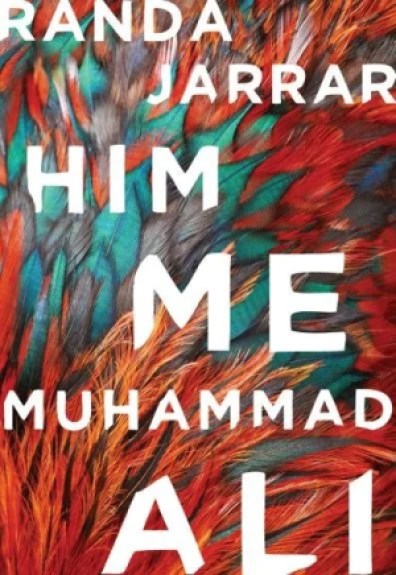
This groundbreaking short story collection was among my first exposures to queer Palestinian literature. And what a force! From the unforgettable opening story, wherein the narrator dumps her boyfriend for the literal moon, to one of my all-time favorite short stories that lives permanently on my creative writing syllabi called, “Lost in Freakin’ Yonkers,” Jarrar crafts unforgettable protagonists, plots without a single boring moment, and seamlessly weaves between sur/realist modes in ways that feel so apt to our existence as queer Arabs. I remember gifting it to my own mother and other women in my family, years ago, only to receive weeks of text messages about how they’ve never read a book that has made them feel as seen and represented in the English language. — GA
Fire in Every Direction by Tareq Baconi (Memoir)

This book, like many pieces of great literature, feels like many-in-one: a familial Nakba story, a queer coming-of-age story, a memoir of one of our community’s great intellectuals, a reckoning with the state of our world writ large, and further, an insistence that such a reckoning cannot happen without confronting our most intimate and abject. Although Baconi’s past and future books are more academic in tone, this memoir is a searing, page-turner of a book. Of the books on this list, it is the one I read the fastest, propelled forward, simultaneously, by the compelling narrative and gripping writing. The chapter of this memoir on confronting the abject is single-handedly one of the most memorable pieces of writing I’ve read in the last decade, and it literally and thematically reverberates across many titles Hannah and I have listed here. Reading this book while visiting home, and in particular reflecting on my own queer closeted upbringing in the U.S. South, only made it hit even harder. Readers who have experienced queer heartbreak, just like readers who care about our interconnected communal liberatory future, will not leave this book with dry eyes. An absolute force, and in my prediction, destined to become a classical Palestinian Anglophone literary text of our age. — GA
Namesake by N.S. Nuseibeh (Memoir)

This memoir in essays by British Palestinian professor N.S. Nuseibeh takes a unique approach in its format, which centers around the exploration of her namesake and ancestor, Nusayba bint Ka’ab al Khazrajia. Nusayba was a mythic warrior, mother, and early convert, who fought alongside Prophet Muhammad at the dawn of Islam. In this memoir, N delves into the experience of being an Arab woman today and in the distant past, taking her from superheroes and the glorification of violence, to the rise of Arab feminism, to what courage looks like in the context of interminable conflict. This memoir is a smart and witty investigation of gender, sexuality, identity, and religion that I continue to think about to this day. — HM
The Hollow Half by Sarah Aziza (Memoir)

When first blurbing this book, I wrote: “Never have I read a book that has made me feel as loved, held, and cared for, in my Palestinian body, as The Hollow Half.” Over a year later—after having taught this book and read alongside Sarah cross-country—I still cannot find a better way to describe it. This memoir is so well-written at the level of the line, my first reading was sheer awe, marveling at the care and labor Aziza put into crafting this tale of displacement, recovery, eating disorders, and Nakbas public and private. On subsequent re-readings, I came to love it most for its non-linear structure: The book is not organized by linear time, but is ideationally and narratively organized by Arabic thematic chapter titles. As Fady Joudah has beautifully articulated in his review, citing the dynamics of Palestine in Arabic versus Palestine in English, somehow, Sarah Aziza’s memoir has given us a Palestine in English returning to Arabic, a Palestine in Arabic that was always omnipresent but that we weren’t capable of reading. Aziza leads with her heart as much as with her capacious intellect, as exemplified by the book’s footnotes, connecting a story of Palestinian living to lineages of Black feminist thought, queer/trans literature, and disability justice work, in such cohesive, yet accessible, ways. Aziza has truly given our community an abundantly life-affirming text, to a world that has cast Gaza aside and truly does not deserve her or any of our precious kin’s words and worlds. — GA
Mis(h)adra by Iasmin Omar Ata (Graphic Novel)

From the trans Palestinian comic artist also known as Delta, Mis(h)adra is a riveting look into the life of a young Arab-American man living with epilepsy while trying to navigate college, the U.S. medical system, and family. Based on their own lived experience, Delta illustrates their disability through the use of light and color that jumps off the page and immerses the reader in every physical feeling and emotion the main character has. This incredibly raw and captivating graphic novel is an emotional and visual feast. — HM
Terror Counter by Fargo Nissim Tbakhi (Poetry)

To read Fargo Nissim Tbakhi’s Terror Counter, as a text in conversation with a long lineage of Palestinian resistance poetry, feels like reading a conversation between the many forms of resistance Palestinians have attempted, and the impossibilities that resistance will require of us to see a free Palestine in our lifetimes. On one hand, these poems feel like a search for a form capable of holding and carrying Palestinian life from this world into the next one. On the other hand, these poems pierce me hardest when they look, unflinchingly, into the most abject of spaces, the most difficult distances: the distance between the reader of an ordinary American poem and a soldier committing a genocide against our people, as in “An American Writes a Poem,” or the distance between father and son, between il/legibility, in the collection’s penultimate poem, “In the Knowledge That You Will Die, and I Will Die.” Here is a loneliness that feels earth-shattering. Every moment of beauty, unafraid to name the sea of terror from which it was sourced. Every craft decision, reminding us that our duty must be to uncraft this world. Uncompromisingly resistive, searingly intimate, and apocalyptically clear, Terror Counter is a text I have assigned on several syllabi, despite only being out for a year. This is perhaps the loudest way I can say I love you:to say thank you for being a text to study, to return to, to become and attempt all the necessary unbecomings with. To say I love you as in I am of you. — GA
Homosexual Intifada: A Queer Palestinian Anthology edited by George Abraham & Hannah Moushabeck (Anthology)

Edited by George and I, this first ever queer Palestinian anthology (to be published in the United States) includes nineteen contributors whose work spans essay, memoir, speculative fiction, poetry, photography, comic art and short story. From an interview with three trans women surviving the genocide in Gaza, to a retold queer auntie hakawati from Randa Jarrar, this anthology offers vital contribution to queer literature, Arab identity, and decolonial thought. — HM


