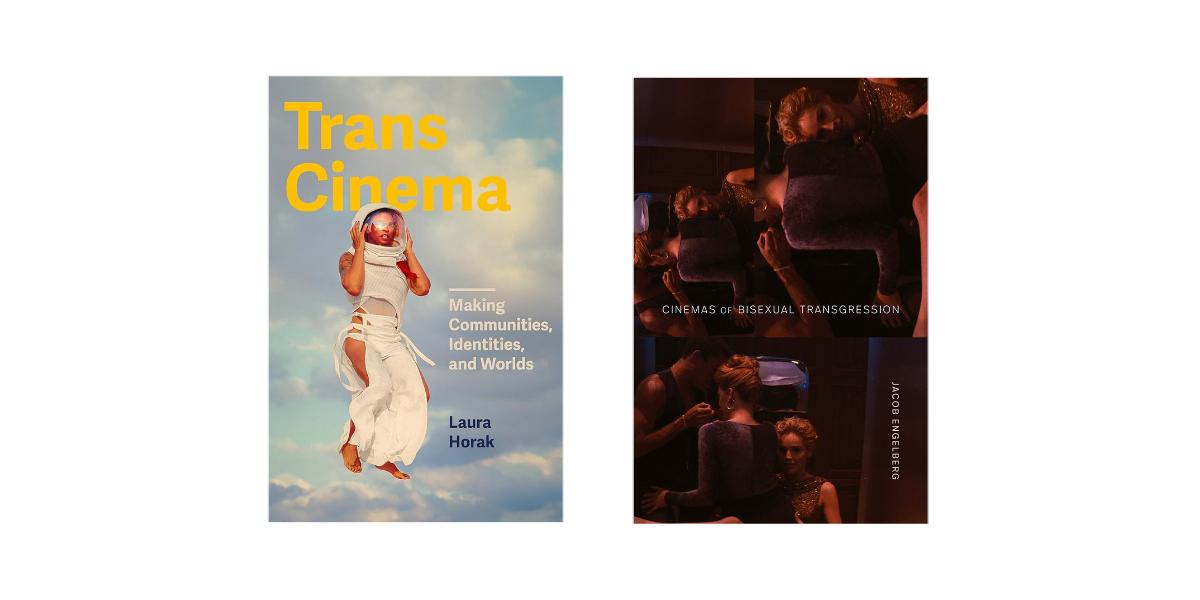
Two new books published this year aim to transform the field of queer and trans media studies. Trans Cinema: Remaking Communities, Identities, and Worlds by Laura Horak and Cinemas of Bisexual Transgression by Jacob Engelberg center trans and bisexual films and figures in their analysis to expand our ways of seeing and thinking about LGBTQ+ media.
“What do trans-made films do?” Horak asks in the introduction to her book. Horak is a Professor of Film Studies at Carleton University as well as the director of the Transgender Media Lab and Transgender Media Portal, an IMDb-like site that enables users to discover films and videos by trans creators. Her tour-de-force new book argues: “Trans filmmaking can create new worlds of possibility, new glimmers of possible lives.”
Engelberg, an Assistant Professor of Film, Media, and Culture at the University of Amsterdam, is similarly interested in how bisexual representation on screen can make, or unmake, the social and sexual worlds around us. His book specifically looks at figures of “bisexual transgression” on screen. These are characters that break “social and political rules, ethical and moral norms, [and] conventions of film form.” In other words, he’s interested in bisexuals behaving badly. Engelberg argues these representations “offer glimpses of bisexual possibility” that challenge the straight-gay binary, as well as binary systems of sexuality more broadly.
Both Horak and Engelberg are interested in moving cultural conversations about bi and trans media beyond the positive/negative dichotomy through which characters are often evaluated. Rather than assessing if particular films and TV shows offer us “good” or “bad” representations or if they are beneficial or harmful to the community, Horak and Engelberg want us to think about how we can examine these media otherwise. Both writers employ tools of film theory to do this analytical work.
For Horak, this means looking specifically at films, TV shows, videos, and web series directed by trans people. She asks, “How do trans artists, who live in societies that tell them that they shouldn’t exist, nevertheless manage to create work that not only defends their existence but also demands pleasure, imagination, and fulfillment for trans people?”
Her wide-ranging case studies throughout the book answer this question. “While political discourse leaves us wanting, art is really good at complexity. Trans-made films are the antidote to thin accounts of trans lives,” she says.
Horak is particularly attuned to the power dynamics at play as a white cis scholar researching trans media. Acknowledging the history of violent, extractive cis research about trans people, she writes at length about her own process and procedures for ethics and accountability, which included hiring trans and BIPOC student researchers and citing trans and BIPOC scholars. She details the goals she set for herself as well as her results, and includes an accountability audit from Kit Chokly, a research assistant and member of the Transgender Media Lab, in the Appendix of the book. Horak’s self-reflexivity and transparency here demonstrate how she worked to align her politics with her research practices in the service of her justice-oriented mission.
Trans Cinema is structured in two parts: Foundations and Key Themes. In Foundations, three chapters give us information-rich histories of trans representation in mainstream media, independent trans filmmaking, and (most interesting to me!) trans film festivals. “The story of trans cinema is richer, more innovative, and more complex than what the media would have us believe,” Horak writes. These first three chapters alone prove this to be true.
Her Key Themes chapters detail how trans filmmakers have explored common experiences and issues, including community and chosen family, sex and desire, family, violence, embodiment and transition, and relationships to the past. The breadth of the book alone is worth noting: Horak writes about fiction and documentary, prestige streaming TV series and low-budget web series; live action and animation; and mainstream and indie film. While Horak humbly admits that Trans Cinema isn’t a comprehensive account of trans media (if such a thing were even possible), the sheer number of film and media objects she deftly explores in the span of the book is incredibly impressive.
Horak gives each of her case studies its due, exploring their historical and political contexts, their production and distribution, and their aesthetic and storytelling innovations. She often supplements this with information she gleaned from archival research and interviews with the filmmakers themselves. Helpfully, she finishes each chapter with recommended screening and reading recommendations for those who want to dig deeper.
Horak’s fifth chapter, about screen representations of trans kids and parents, feels particularly important in the contemporary moment. As she writes, trans youth have become “hypervisible political footballs” in the last decade, as legislators on the far right have escalated attacks on gender-affirming care, inclusion in sports, and bathroom access across the U.S. Looking closely at documentaries about trans families, she examines how “trans people use cinema to rethink families of origin.” Her chapter shows us that “trans creators use cinema to establish trans children’s and parents’ complex personhood. These works show trans youth as their own canny advocates rather than as victims in need of saving and trans parents as loving and committed but also varied and human.”
Horak makes insightful interventions in each of her chapters, and I highly recommend reading the whole book to sit with the thought-provoking questions and ideas she offers us about each topic. In her Conclusion, she reiterates the central importance of trans artmaking for radical activism: “Trans-made media is all the more important during this time of crisis—to tell the truth about the world (a truth increasingly hard to come by in these lie-drenched times) and to keep remembering what else has been and imagining what else could be.”
Horak ends the book by arguing, “What we need is a better trans audiovisual media ecosystem.” This means a media system where trans artists have ample training and mentorship, where trans-led projects get funded, where trans films are distributed widely, and where trans media is preserved for generations to come. We can create this world collectively: she writes, “The first step is to get the films we already have out there and watch them and tell your friends and family and students and teachers about them.”
I would add that perhaps the first step is to buy and read Trans Cinema. Share what you learn with your communities, so we all can discover the essential work trans filmmaking plays in envisioning and sustaining radical change.
Engelberg’s book is more traditionally academic in writing style, but no less wide-ranging in vision. In exploring images of bisexual transgression on screen, he argues for the centrality of bisexuality to queer film studies, where it has been underrepresented and undertheorized.
Engelberg imagines bisexuality as a lens through which we can find new ways of seeing and understanding queer film. “To read with a critical bisexual eye is to contest the ascendency of a monosexist hermeneutic,” he writes. In other words, interpreting texts through a bisexual lens allows us to challenge norms of monosexism that structure the world around us.
Engelberg investigates “bisexual capacity” on screen, which is “a kind of open receptivity to desirous possibility” beyond a single gendered love-interest. Bisexual capacity has the potential to trouble “the dominant and dominating heterosexual-homosexual binary through which human sexuality has been organized in the West since the nineteenth century.” Deeply in dialogue with queer theory and film studies, Engelberg brings bisexual theory to this analytical table, conveying how it can enrich our understanding of both sexuality and film.
Engelberg demonstrates his bisexual reading practice by looking at examples of bisexual transgressors on screen. His chapters discuss the seductive and dangerous les(bi)an vampires in 1970s exploitation cinema, anxieties about female bisexuality in lesbian narrative film from the 1970s-90s, male bisexuality in European art cinema in the context of the HIV/AIDS crisis in the early 1990s, and a fascinating re-reading of the controversial erotic thriller Basic Instinct (1993). In each of his case studies, he explores how bisexual figures on screen open up spaces of ambiguity that can deconstruct dominant forms of social, cinematic, and sexual organization.
I found his writing on “bi-exclusionary lesbian ethics” in 1970s-1990s lesbian film particularly resonant. Bi-exclusionary lesbian ethics “names a persistent antibisexual axiom: sometimes presented as a coherent political credo, sometimes expressed as a general feeling of social suspicion, distrust, or disparagement—that is discernible in certain expressions of lesbian thinking, politics, or culture.”
This concept identifies how bisexuality has been considered a problem, something suspicious or threatening, in certain iterations of lesbian feminist thinking and in lesbian films of the era. By examining these films, the feature She Must Be Seeing Things (1987) specifically, he demonstrates how bisexuality can trouble tenants of lesbian feminist theory and film narrative, complicating the way we see previously stable forms. While he’s writing about films in the past, I found myself thinking of countless conversations with other bisexual friends about our feelings of guilt and shame dating and sleeping with men as out queer women. Perhaps these feelings are part of our own internalized bi-exclusionary lesbian ethics? I am excited to see how future scholars explore how that concept might help us understand queer and feminist social life today.
Throughout the book, Engelberg’s own writing is cheekily provocative. He opens his Introduction with an analysis of a scene of sexual torture from the notorious film Salò, or The 120 Days of Sodom (1975), in which a group of teenagers, captured by fascists in 1940s Italy, are lying face down, naked and bent over, their asses in the air. “The ass has no gender,” Engelberg writes. He continues, “In Salò’s tableau of seventeen genderless asses, we glimpse the possibilities of desire undetermined by gender, a bisexual erotics.”
Drawn to cinematic and bisexual transgression, Engelberg is often interested in violent case studies – murderous vampires, sexualized serial killers – that some readers may find offputting. But for Engelberg, this is precisely the point: he writes, “Although it may trouble us that this image of bisexual erotics is rendered through violent subjugation, this is a trouble with which it is worth staying.” He wants to take seriously the cinematic figure of the bisexual transgressor, to explore why, where, and how they show up, and what cultural work they can do. He concludes, “These figures’ value, however, is to be found in their elucidation of cinema’s capacity to convey that which lies beyond homosexual-heterosexual opposition through violations of rules that render systems of categorization unstable. Queer film studies is impoverished without them.”
Taken together, both Trans Cinema and Cinemas of Bisexual Transgression remake the field of queer and trans film studies. Each book not only expands the central objects of study; they also call upon LGBTQ+ media scholars to shift our focus to forms of queerness underrepresented in our scholarship. Looking more closely at trans-made media and bisexuality on screen allows us to challenge the dominance of cisgender, monosexual ways of seeing the world around us and invites us to imagine it otherwise.