Social and medical scientists have repeatedly linked marriage to more positive physical health outcomes for its participants — but of course, by “marriage” they usually mean “opposite sex marriage,” and the commonly agreed-upon reason for this result is that without a good woman around, men absolutely cannot take care of their own shit. Just kidding! Actually, not really.

typical
Here’s how the idea that “men count on women to supervise their health” is explained by Corrine Reczek and Debra Umberson in the introduction to their recently-published study “Gender, health behavior, and intimate relationships: lesbian, gay and straight contexts“:
“In order to explain this persistent and well-documented gender gap, previous research has relied primarily on gender socialization theory to suggest that girls are socialized from a young age to care about others’ health, while boys are not.”
Reczek and Umberson were curious, then, about how these dynamics would play out in same-sex relationships. See, there are two elements of gender socialization theory at work here. The “doing gender” theory posits that certain cultural ideals and conceptions of masculinity and femininity lead men to see promoting health as the woman’s job. The “gender relations” approach attempts to discren the interactional elements of this dichotomy, namely that “men’s inattentiveness, in relation to women’s attentiveness, toward health is not merely a function of individual performances of gender. Rather, these gendered performances persist as social practices that are constitutive of — and constitute — a gender order.”
Taken on its own, the “doing gender” theory would suggest that gay male couples probably sit around all day shooting heroin, eating Doritos, avoiding the gym and dodging the doctor, and that lesbians constantly nag each other about why the other hasn’t quit smoking yet. However, I don’t know if you’ve ever seen Anderson Cooper biking around Chelsea with his boyfriend, but if you have (as I have) you’ll probably be skeptical about the idea that men without women cannot be responsible about their health.
Thus, Reczek and Umberson interviewed 50 couples who’d been together for eight years or more, including 15 gay and 15 lesbian couples, to look at “health work” within partnerships, defined as “any activity or dialogue concerned with enhancing another’s health.”

straight people doing "health work" together
Over 75% of the couples they interviewed reported at least one partner “did some form of health work as a result of two reasons: the other partner had bad health habits, or one partner was considered the “health expert.” The heteros reported generally that men were the ones who needed more prodding about healthier behaviors:
“In explaining why one partner performed specialized health behavior work while the other did not, men and women in gay, lesbian and straight relationships framed one partner as having inherently unhealthy behavior in need of intervention…. in straight couples, men were typically framed as having unhealthy behavior in need of health work.”
Straight couples who identified one partner as the “health expert” almost exclusively said it was the woman of the house, and many referred to their wives as “health nuts” or “the health person.” Meanwhile, gay couples eschewed “health nut” shorthand and were more likely to provide detailed explanations and background regarding one partner’s superior knowledge in a specific health area. (Sidenote: The “health expert” concept is kinda funny ’cause it’s SO TRUE, there’s always the one person who takes that role, right?)

health nut attempts to pull her slacker husband away from a flat glass of beer
The most striking results of all came when looking at “cooperative health behavior work,” described as “times when they and their partner worked together in mutually reinforcing ways to promote one another’s — and their own — health behavior.” 80 percent of gay couples and 86 percent of lesbian couples reported cooperative health behavior work… compared to ten percent of straight couples. TEN PERCENT!

straight people
Gay couples described things like running and making healthy-eating efforts together, keeping each other “in check” about excessive alcohol abuse and tailoring one’s fitness routine to include the other.
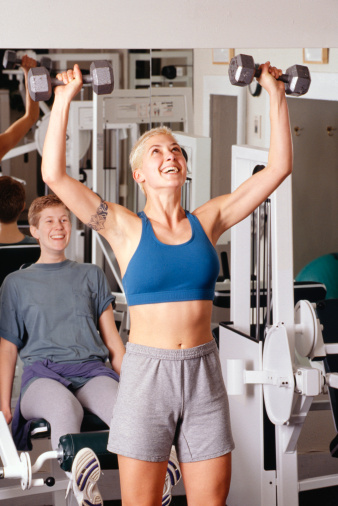
lesbians cooperatively exercise
+

gay couple cooperatively shops
The researchers concluded:
“Our analysis shows that gay men and lesbian women describe performing specialized health work in ways analogous to straight women. This suggests that health behavior work does not depend on whether an individual identifies as a man or a woman, but rather the relational and institutional contexts in which men and women enact gendered selves and sexual identities.”
But why, exactly, are gay and lesbian couples dramatically better at cooperative health work than straight couples? For starters, this is in line with other research that shows same-sex couples handle household chores and other “unpaid work” in a more egalitarian way than straight couples, although really arguably that’s just by default.
Reczek and Umberson suggest that there are other factors specific to gay culture, like that “two gay men may mutually draw upon alternative notions of masculinity that place emphasis on physical fitness and appearance and perform cooperative health behavior work to achieve this common goal,” that could impact results.
Furthermore:
“…the social and institutional conditions within which gay and lesbian couples live – including a heteronormative and homophobic culture at large, and a non-institutionalized nonheterosexual union – structure a unique relational context for cooperative, more egalitarian health work processes to emerge.”

egalitarian health work is especially easy when you have a nice getty images kitchen
Although it’s much less interesting than the gender theory stuff, I’d be interested to know what impact sex-specific health needs/factors have on these sorts of results — as in; to what degree the biological differences between cisgender men and women affect their ability to take care of one another’s health. A straight guy is unlikely to have much insight on his girlfriend’s yeast infection, but another girl usually will, and often the closest “other girl” for a lesbian is her girlfriend. Once you reach a certain age, it’s likely that even if your girlfriend hasn’t personally dealt with your health issues, she’s got an ex-girlfriend who has and therefore subsequent insight.
Having dated men for seven years before switching over to the ladies, I was actually surprised (and relieved) at first by how different it was to date someone with whom my physical health was discussed. With men, I always felt it was something I just took care of on my own, or with the support of female friends. (To be fair, though, I stopped dating men at 23, I imagine discomfort around personal health issues may fade when you get older or are in longer-term relationships.) To be honest, I don’t think I would’ve been receptive to “health work” delivered by a man, and the only time I engaged in “cooperative health work” with a boyfriend, it quickly turned into a calorie-reduction contest/cooperative eating disorder!
Speaking of consuming or not consuming things; dramatic differences in metabolism between genders have a major impact on our bodies’ responses to adjustments in nutrition and fitness as well as the processing of drugs and alcohol, which are the two areas in which our health outcomes are most easily impacted by our partners and for which “cooperative health work” was often cited. That definitely gives same-sex couples an upper hand for working cooperatively in those areas.
We are educated throughout our lifetimes about how to take care of ourselves, and that education is very gendered, which gives us all a good base to take care of our same-sex partners. But where opposite-sex partners are concerned, it’s also a truth universally acknowledged that women are incidentally told a lot more about men’s health than vice versa because men dominate the cultural conversation and the media (a.k.a., “because of the patriarchy”).
There’s also the broader issue of political disenfranchisement. If we don’t look out for each other, who will, you know? We’re less likely to be insured, for starters, and we’re more likely to fear doctors and be disconnected from our families or other communities. Historically, we’ve achieved pretty incredible feats of community care-taking over the years, especially when AIDS first broke out and the medical industry shunned gay men seeking help or treatment.
We hear so much about negative health outcomes for LGBT people that it’s nice to have at least one little study that shows even though we’re often on our own out here, we do a pretty damn good job of taking care of each other.

women enjoy the ecstasy of lesbianism


This doesn’t surprise me, infact I’d even make the controversial assertion that same-sex couples are just better matched than opposite-sex couples. Men and women will never completely understand each other. There are things about the opposite sex that are mysterious and unfathomable, why they act a certain way or say one thing and mean another. It leads to no end of conflict in opposite-sex relationships, and partners generally see each other as more complimentary to each other than equal, yin and yang.
Same-sex couples, on the other hand, do understand each other. Two people of the same gender ‘get’ each other, which is why our best friends are usually the same gender as us. We know how we think, we know why we do things, and we know what we really mean when we say something. It helps us form harmonious relationships with each other, whether platonic or romantic. We have conflicts too of course, but we find it much easier to see each other as equals rather than of two different species.
People only see other genders as mysterious or alien because they’ve been trained to. Just like hetero dudes have been trained to be dependent on women for their health needs. In reality, the differences between individuals vastly outweigh the tiny differences in averages between genders.
Your assertion is controversial because it is essentialist bull that should be put back in antiquity where it belongs.
Ok I guess I deserve that. It was just a little lighthearted speculation on my part.
I don’t know… my best friends have always been guys, I’m ridiculously uncomfortable around ladies and feel like I never understand them. So I guess it depends of the person.
i think there’s some merit to your point, in my opinion… i’ve always wondered about that, but i know it’s essentialist to say so (but also, even if the differences are a product of socialization, they are still differences at this time, until we overcome that socialization) … like if part of being gay isn’t just that you want to bone people of the same gender, but that you as a person are more wired for a more intense relationship. that’s just from my own personal experience though, but i don’t think it should be discounted as possible for some people, even if it isn’t everybody’s experience.
“but that you as a person are more wired for a more intense relationship.” THIS!
Now on one hand I am attracted to women, physically. So intense or not, I like boobies and other things…
But, I’m also not willing to call myself a lesbian because I identify deeply with the person, so if I feel like we vibe then I’m all in. So the guys I’ve dated fall into that category. It was easy bonding with them and being corny or super deep.
And I like girls (outside of the fact that I like boobies and other ribald things…) because it’s so much easier to get to that level of intensity. Which then makes other things so much better.
The average straight male hasn’t found a reason to break out of the patriarchal pedestal of emotional unavailability and privilege awarded him. So… it makes it really easy for me to like women.
Note: I don’t want to trivialize or make it seem as if I like women because men are the way they are. I’m just attracted to people who get me.
“even if the differences are a product of socialization, they are still differences at this time, until we overcome that socialization.”
That right there.
I wasn’t convinced by the cited study, because words can be manipulated. The pictures are what convinced me.
It was the men happily shopping for veggies while wearing a giant triangle pin (as you do) that did it for you, wasn’t it? I know it was for me.
Ahahaha… The ecstasy of lesbianism. True. It’s all true!
Riese, another great article! Thanks for your analysis and insight!
And yes, I totally agree that same-sex couples are (1) more equal and (2) more understanding when it comes to mutual health decisions/goals. Yay for us Gays!!
awww, i wanna tandem bike into the sunset…
That was a great article and the pictures really enhanced it
I just came back from a vegan, fair-trade products, and let’s talk about feelings in a constructive manner potluck with some lesbians and two gay men.
Like I feel like I increased my life expectancy by 2.5 years.
It’s real.
I’d like to know why “it’s also a truth universally acknowledged that women are incidentally told a lot more about men’s health”??
Also, the last picture=lmaoo
because of the patriarchy
we just know a lot more about men than men know about women because men control the media and the government
Riese, I just wanted you to know that I’ve introduced BOTP to my circle of friends, and it’s been a big hit. Granted, more than half of it was dudes immediately appropriating it to use as a trump card when we’re arguing about something chivalrous they’re trying to do, and they’re like, “No, I insist on taking the couch. BOTP.” So there you go. The introduction of a social justice term and its appropriation to reinforce patriarchal norms in a matter of hours.
Yeah and also from an early age guys are allowed/encouraged to think most of what happens to girls during puberty (besides growing boobs, natch) is “gross.” Talk to a guy about your period and you’re forcing something horrible on him. Whereas Cosmo spends like 50 pages an issue talking about the intricacies of penises.
Also it seems universally acknowledged that men’s health is “simpler” to deal with/understand than women’s. This all reminds me of Rachel Maddow’s “Man Cave” segments when she tries to explain shit about the uterus to unwilling male viewers — hilarious but mostly b/c it’s real (BOTP man).
Also, I think society’s period terror is a huge factor. I don’t know, everyone seems terrified of teaching boys about periods, and that’s like a pretty minor health point to stop all education at. I’m not up on what’s goin into sex ed these days, but in my sex ed (eight years ago) we had to learn about boners, wet dreams, etc and the boys were told that periods were a thing but not told what they actually were. Maybe maturity is a factor used to keep it that way.
Whoops, you already said my comment but better.
i.e. the most common symptoms that most people think of when they think heart attack or any major cardiac episode don’t actually happen to every patient and many women often have cardiac arrest w.o any chest pain at all, and don’t recognize their fatigue/sleep disturbance/ shortness of breath as symptoms that are experienced by most women who have heart attacks.
(just as an example, because my mom had been tired for months before going to the hospital 2 years ago, and didn’t think it was a heart problem because she had no chest pain-the most widely discussed symptom/the one portrayed most in all media)
“times when they and their partner worked together in mutually reinforcing ways to promote one another’s — and their own — health behavior.”
um, sex?
basically, gay couples have more sex.
(take that, lesbian bed-death!)
I enjoyed the captions in this article.
I read this while eating tootsie rolls so I feel kinda bad now, but I’m going to keep telling myself I do wheat grass shots in the morning and that makes me a good health person.
“…and the commonly agreed-upon reason for this result is that without a good woman around, men absolutely cannot take care of their own shit. Just kidding! Actually, not really.”
I blame Steve Harvey.
The only thing this article is missing is a picture of a woman laughing while eating salad.
http://thehairpin.com/2011/01/women-laughing-alone-with-salad/
Great article. I’m glad to know studies like this are being done, I had no idea. Now, excuse me while I nerd out and read that entire study.
“To be honest, I don’t think I would’ve been receptive to “health work” delivered by a man, and the only time I engaged in “cooperative health work” with a boyfriend, it quickly turned into a calorie-reduction contest/cooperative eating disorder!”
This this this. I was going to say this: I would’ve reacted defensively and insecurely if my boyfriend suggested I not eat certain things. I would have seen that as his “polite” attempt at policing my body for his own purposes. But the same comment from my mom or my girlfriend would be coming from a place of concern and love.
Basically, I hate men and won’t take any of their advice #BOTP