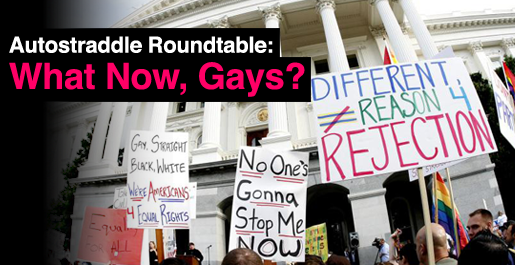
Soooooo … Prop 8 was upheld. That was neat. What do we do now?
In the hours and days following the court’s decision on Prop 8, many pundits, politicians and writers started talking about where we go from here. Do we try again in 2010 or 2012? Should we dump gay marriage as a cause and focus on universal health care and better adoption laws? Do we re-think our approach, supporting only organizations, businesses and political leaders who actively support our values? Perhaps we should concentrate on earning rights for all unmarried people? Do we take it to the streets?
So we decided to talk about what we think should happen next — and what needs to happen for Prop 8 to be overturned with the ultimate goal of equal rights for all. What’s holding us back, what can we do, what other things need to happen in America for our laws to change?
Autostraddle Roundtable:
What Now, Gays?

CARLY:
There’s SO MANY THINGS that need to be changed/fixed/improved, so while I do feel that “Don’t Ask Don’t Tell” should just go away already, I’m gonna actually write about something else I feel very strongly about—the separation of church and state!
Disclaimer: I am not an expert, nor did I do any research to accompany the following paragraphs.
Back in middle school & high school, we’d read about all the great lengths our forefathers went to to ensure a strict separation between church & state and blah blah blah but we all know what that really means. We’re “one nation, under God,” so obvs this church/state thing was problematic from the start.
And since we don’t have time machines (I wish!) and can’t go back and try to explain to the old white dudes in the powder wigs about abortion and gay rights and all that good stuff, we have to figure out how to make it work now.
What each couple does with their civil union license is their choice. They could get “married” at their church or synagogue! They could have a small party for their friends and family! Or they could do NOTHING at ALL! It’s entirely up to them based on their families and beliefs. Done and done.
Unfortunately, I don’t think there will come a day in the US where we will have an actual separation of church and state, I think it’s (unfortunately, in my opinion) too much a part of what we are. And when I say “we,” let me be clear: it’s a “we” that I don’t feel as though I’m really a part of. Maybe it’s because I don’t agree with war, maybe it’s because I fully support an individual’s right to choose what is best for them, maybe it’s because I don’t currently have equal rights under the law. But I live here and I’m a citizen and I’m not planning on revolting or leaving any time soon. But there are certain things that the federal government can do to ensure that things get on a better path.
Don’t try to change the definition of marriage—remove it from all government and legal documentation and jurisdiction from here on out. The term “marriage” is causing far more bad than good and besides, it’s an outmoded patriarchal institution that is rooted in misogyny and other terrible things. States should be giving out civil union licenses, not marriage licenses. And we already know what a civil union is—same thing as “marriage” but without the name (in most instances). So just get rid of the name. Then, any consenting couple can go get a civil union license, which grants them all of the rights and privileges as married couples are granted now, just with a different name. Then, what each couple decides to do with that is their choice. They could get “married” at their church or synagogue! They could have a small party for their friends and family! Or they could do NOTHING at ALL! It’s entirely up to them and their families and beliefs. Done and done.
Certainly, in my personal idea of a Utopian society, there’s very little organized religion and the government leaves its citizens alone, but obviously that’s not happening any time soon. If we are able to remove religiously-based terms and institutions from federal and state government, though, I think that it will lead to bigger and better things over time.


ALEX:
In my humble roundtable opinion, there’s nothing more effective and important in our everyday little gay/bisexual lives than being 100% honest about who we are to ourselves and to others around us.
Note: I didn’t use the term “come out” in that sentence. Not to get annoyingly specific about my own situation, but I never “came out” to family and friends because it just wasn’t for me. I felt it would perpetuate categories with them. I’ve only “come out” strategically in conversation with strangers.
Example: In a conversation with a few friends and acquaintances, one in particular felt it appropriate to throw around gay slurs and “faggot” and misogynistic language as well (cause they usually go together, right?)
Agree with how hot the waitress is when the guy next to you does. Proclaim your love for Jennifer Beals to your friends when they’re all hetero-crazy over Zac Efron (he’s totes cute, so you can agree with them too!)
So my interjection was “Um hey! Did you know I’m gay?” and I think it threw him off a bit. So he says“Yeah!” and I continue with “So is there a problem with that?” “No. Not at all.” That’s all it took, really. He started back-tracking. Even if this guy’s behavior or general opinion hadn’t changed at that moment, the seed had been planted. He saw that it wasn’t safe to use those words after all, that his opinion wasn’t universally respected by those around him.
I don’t think many people (or friends/acquaintances/strangers) want to offend us right to our faces.
The thing is, if this gentleman’s language was racist, you know he wouldn’t dare talk like that in front a black dude. It’s scary that we have to let ourselves be known because it’s not always written on our foreheads. But I’m telling you, for yourself and for the rest of us – it’s totally worth it. It’s all that we CAN do right now.
And this stuff doesn’t always have to be confrontational! Agree with how hot the waitress is when the guy next to you does. Proclaim your love for Jennifer Beals to your friends when they’re all hetero-crazy over Zac Efron (he’s totes cute, so you can agree with them too!)
You’re a girl. You like girls (and maybe even boys sometimes too.) It’s as simple as that and there isn’t a damn thing wrong with it. Own it, girl.
“If a bullet should enter my brain, let that bullet destroy every closet door.”
(Harvey Milk)

RIESE:
Yes! Now I can talk about my favorite topic, Symbolic Annihilation, or the “absence of representation in the media.” Sociologist Tuchman divided the concept into three aspects: omission, trivialization and condemnation. In 1991, Larry Gross’s essay “Out of the Mainstream: Sexual Minorities and the Mass Media,” applied this specifically to gay people: “The gender system is supported by the mass media treatment of sexual minorities. They are ignored or denied – symbolically annihilated … of all social groups (except perhaps communists) we are probably the least permitted to speak for ourselves in the mass media.”
Furthermore, “representation in the mediated ‘reality’ of our mass culture is in itself power … when groups or perspectives do attain visibility, the manner of that representation will itself reflect the biases and interests of those elites who define the public agenda.”
There are a lot of people who will never respond to our anger, our rallies, or even to our straightforward pleas for empathy & understanding—the only way to reach many of these people is through media visibility and responsible representation.
The sad truth is most people are ignorant and don’t pay much attention to political nuance, or to questioning indoctrinated religious ideals and right-wing propaganda. Furthermore, I suspect a lot more stalwart hearts & minds were changed by Portia being on Ellen than by any PSA or rally.
There are a lot of people who will never respond to our anger, our rallies, or even to our straightforward pleas for empathy & understanding—the only way to reach many of these people is through media visibility and responsible representation.
This doesn’t have to be a compromise, because I don’t think there’s anything about our stories or our art that’s inherently distasteful to anyone, or inherently “fringe,” and I think it’s possible we can tell our stories honestly and be heard on a mass level without sacrificing our queer sensibility or community solidarity. Outsider voices are always where the interesting and exciting stuff is happening anyhow.
We need to be seen and it needs to be GOOD. TV shows, movies and also in the news—people need to know stories like this one are happening. As lesbians this is particularly important—and difficult—we struggle against sexism and homophobia and the patriarchy, and many of us also must contend with racism. Gay men are further along than we are w/r/t media visibility, I think, and part of that is ‘cause men are conditioned socially to believe they are worthy and powerful, and that’s how despite our society’s aversion to the perceived threat on masculinity posed by homosexual men, when it comes to business deals and big media, they’ve still been able to get things like Will&Grace and we got um … um. A few eps of The O.C.?
We’re worth it, we must believe that we are worth it. We must fight hard for the social and cultural capital that will get us into the political arena, we must never give up on that.
When people feel they are seen, or feel they have allies or women they can relate to, they will feel more comfortable coming out to their families and friends. Then change will really begin. We will turn far-away faces into human face-to-face faces!
“An oppositional strategy is the subversion and appropriation of mainstream media, as well as the occasionally successful infiltration … the ultimate expression of independence for a minority audience struggling to free itself from the dominant culture’s hegemony is to become the creators and not merely the consumers of media images.”
(Larry Gross)

NATALIE:
So, the question: What is the biggest thing that needs to change in order the LGBTQ community to achieve equality, including in marriage??
Eeeeeks! I am going to talk a bit crazy now, a bit broad and abstract-y. Bear with me. An overhaul/realignment of the “value” system in the US is necessary. There is an urgent need to stop(!) policing sex, proscribing gender, and regulating sexuality; we need to delink religion and policy; our policies should be based on equality, respect for diversity/differing realities and experiences.
Hey parents, grandparents: stop teaching hate and discrimination. Let people be…people. Full and whole. Teach love and acceptance, even if you disagree or dislike.
A changing of public sentiment toward gender and sex must happen. How? This is the question. I suppose the answer lies somewhere in the realms of education, media, visibility, and representation.
I think education and media are key: this is how minds change. The older generations can play a huge role, too.
Hey parents, grandparents: stop teaching hate and discrimination. Let people be…people. Full and whole. Teach love and acceptance, even if you disagree or dislike. It is not your place to police others’ lives (this is what Jesus would want, I am sure of it …in fact, I am sure that religion, by definition, preaches the “be nice, don’t judge” doctrine. No? Also, trust in younger generations is important-we all have things to learn from one another.
So, the big picture: shifting public perception. Also, though, I imagine specific interventions are useful: securing the right to marry, removing “the don’t ask don’t tell” policy, teaching sex education in schools from a non-heteronormative stance…
It is here that Obama and US government representatives need to step the FUCK up!

CRYSTAL:
I don’t want to appear like an ungrateful Gen Y-er, but I think my country (Australia) would be closer to achieving equality if younger people were able to take on more prominent positions in the parliament and the media.
My country is still being run by Baby Boomers who are set in their conservative ways, and said ways do not favour unicorn concepts like gay rights…
My country is still being run by Baby Boomers who are set in their conservative ways, and said ways do not favour unicorn concepts like gay rights or same-sex marriage or civil unions etc. So I guess Gen X needs to start rising up and creating change, ‘cause it’s my belief that the public would be open to it. In saying this, Australia has a habit of blindly following the USA’s footsteps and so the more cynical side of me sometimes feels like we won’t see equality until it is achieved in the USA first. But we’ll see. My country often surprises me and I hope it keeps doing so in all of the good ways.

BROOKE:
One of the most important issues facing our community right now is a perceived lack of financial capital. Money talks. Until queer women are viewed by others (as well as themselves) as having a sizable pocketbook, we will never be able to leverage ourselves into having and maintaining a strong voice in the social, political or cultural arenas.

ROBIN:
Knowledge is power! Sex education is extremely undervalued and under taught in this country and I think a change in how we approach gender and sexuality, both in our schools and in our homes, would make a huge difference in helping children grow up to become self-aware and progressive adults. My opinion on this topic is based on my own experiences with sex education, or lack thereof.
First off, my family was never comfortable talking about sex. I didn’t learn anything about sexuality or my body at home aside from the basic idea that in order to create a biological human baby, a man must insert a certain unspeakable appendage into a woman’s body (but only in the context of a loving, sound, “heteronormal” marriage). This scenario sounded so awful that it served as decent birth control for me from ages 8-12. After that, I was left to my own devices.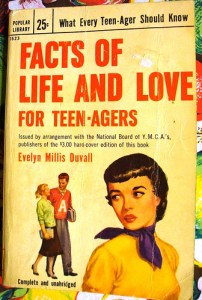
In middle school I underwent the classic coming-of-age sex ed experience: boys and girls were divided into separate classrooms to clinically discuss how babies are made and the sessions focused mainly on a vague chart of male sex anatomy. I assume the school felt a young woman didn’t need to learn anything about her own body, that instead our learning should focus on the greatest of all human feats—baby-making (again, only between a man & his wife)—and then we should be able to figure out the rest. Oddly enough, the gym teacher was our lecturer and I’m pretty sure she was a gay lady.
In high school “sex ed,” we were told to walk around the classroom and write down the names of five classmates of the opposite sex. After I’d finished asking five boys how to spell their last names and was waiting, confused, for the point of this exercise, the teacher explained that writing down these names represented that we had had sexual relations with these people. As if that wasn’t disturbing enough, we were informed it’s ‘cause we didn’t use protection and one person in the class had AIDS and now we all had it! Then the bell rang and it was time for Social Studies.
As if that wasn’t disturbing enough, we were informed it’s ‘cause we didn’t use protection and one person in the class had AIDS and now we all had it! Then the bell rang and it was time for Social Studies.
I walked out of there with so many questions—What the heck is AIDS? What protection is available? What if you’re GAY?!!? How do gay people use protection?— and looking back now at the sex ed I was getting while going through puberty and entering adulthood I feel almost physically ill. Isn’t there a better way of informing students about HIV/AIDS and teaching them about a healthy sexual life? I was confused and unaware of my sexuality until about age 22, when I started figuring it out. That was six years ago.
My public high school required all seniors to take a class called “Family Living,” though all anyone seems to remember from it is that my friend Kim had to get married. Luckily I missed out on the underage heterosexual wedding planning fun ‘cause I was learning about “Modesty” in a sex-seperated classroom at a Christian boarding school in St.Louis, MO.
Anyhow, you’d think a Northern New Jersey public high school would be more progressive by now, but they still offer it (wording slightly changed):
“Family Living is a one marking period unit stressing analysis of contemporary and traditional attitudes and values as they relate to family life. The emphasis of this course is placed on masculine and feminine roles, the nuclear family, lifestyles and marriage law.”
The lack of sex ed not only contributes to problems like teen pregnancy and STDs, but also does damage to the LGBT community. Children can’t develop self-awareness or understand their sexuality/gender identity while constantly being taught to ignore your urges, set aside your questions and slap on a smile & a wedding dress. Teaching “gender roles” is damaging and not teaching children about all the glorious forms of sexuality is even more dangerous. Kids need to know that they’re not alone—that they’re okay, normal and beautiful no matter how they identify. If they felt comfortable with themselves, they would be able to be themselves at school and with their families.
World thought on the LGBT community would change a great deal if previously homophobic kids (of course this is a LEARNED behavior from homophobic parents/friends/teachers) were taught about love and sexuality in the same breath. If these kids were taught about a healthy way to explore their own sexuality and given a platform to be able to ask any questions they please, they’d come home and say “well, my teacher taught us today about LGBT issues and here are the facts…”
I believe strongly that homophobia is more easily changed in the hearts of the young and progressive. As time goes on and correct and proper education prevails over wacky religious rhetoric, children will grow up in a world where they will be impressively self-aware. They will teach their parents and bosses and friends about sexuality, gender and true equality. I already see it happening.

TINKERBELL:
Hello Homosexuals, it is Tinkerbell. As a dog I do not have many rights, for example I cannot join the army, vote, or smoke the ganja. I also have special privileges like I do not have to work, also my love for Littlefoot my boyfriend and for Kelly Clarkson. What I do not enjoy is people saying a woman marrying a woman will lead to a woman marrying a dog. I do not want to marry a woman. I am very little and she would crush my bones. Humans have human laws and dogs have dog laws, human laws should be equal for all humans and they can be equal for all humans without involving dogs. What is wrong with you people. Love Tinkerbell.


I don’t think we need any new laws. Every law we could possible want is already in existence, it just isn’t interpreted to be inclusive for everyone. What this country needs is a healthy dose of legal revision…and in the case of DOMA/DADT legal repealing.
———–
I also really love the generational differences pointed out by many members of the roundtable. One of the first things my mom said after I came out (and after quite a bit of crying) was “I’m glad your grandmother isn’t alive to see this.” It wasn’t that mom didn’t love me, or didn’t wholeheartedly support me (she’s the greatest)…it was just that grandma, in all honesty, was a bigot. And a racist. And she really liked to vote. Grandma didn’t understand, much of her generation doesn’t get it, but they aren’t always going to be around and the most reliable voting bloc in the country.
———-
i also love when tinkerbell participates in anything.
You know what was so weird to me? that because of all the generational differences I have heard so much about, I was never going to tell my grandparents — and i was told by a family friend who’d read my blog that my grandma never needed to know. and then i found out that she does know, and she just wants me to be happy and stuff. but also, i think maybe I am very lucky, family-wise.
—
tinkerbell loves to participate.
I think a lot of times we don’t give the older folks enough credit. Like they are super fragile or something when, in fact, they are probably stronger than us.
My girlfriend and I have been together so long that it is pretty much impossible to hide the true nature of our relationship from family members, yet out of respect for her mother’s request we never formally told her grandparents about us. When her grandfather passed away last year, without us saying anything at all, her grandmother listed me in the obituary along with all the other spouses of the children and grandchildren.
bren, i love that you were included! i’m glad to hear that you and riese (and i’m sure others) have more positive experiences with the older folks.
omg, that’s the (biter)sweetest story ever.
Um…Robin, what the hell was wrong with your health teacher? That whole AIDS exercise is beyond bizarre.
This touched on something that has been bothering me lately and that’s kids. The “I’m confused” NOM ad basically says that opposite marriage must be protected for the sake of the children because, apparently, if kids find out about the existence of gay folk they’ll burst into flames or something. Well, what about gay children? Do they not matter? Is their emotional well-being less valuable than that of a straight child?
If the Bill O’Reilly’s of this world are really concerned about protecting children, all children, like they say then how about promoting a positive inclusive atmosphere so that our young brothers and sisters don’t feel so alone and wrong and different. All this “protection” the crazy Christians seem to want for kids can do untold damage to a certain kind of kid.
I just wonder why no one calls them out on their shit and asks why they seem to consider gay kids driven to suicide by their heteronormative propaganda acceptable causalities.
honestly that whole AIDS exercise made me lose my shit. i was laughing so hard. bizarre indeed but funny/awesome (in a terrible sort of way), yeah?
we did the aids thing too! we also did a fun [not] exercise where we all had to spit into dixie cups filled with water and then “have sex”/combine our cups with each other. at the end, she had us all pour our little cups into clear containers so we could see how disgusting they were. ew.
that is so wrong on so many levels.
all I remember from sex ed was something about female condoms.. the rest was just us being immature and giggly– and pregnancy talks
i don’t remember anyone in my high school being out except MAYBE 2 people – I was talking bout this with my senior year english teacher over my break and she said “this school has changed alot since you were here (2004)” I take tht as a good sign of kids being more open
I went to this private school where the sex ed teacher told us she loved having sex with her husband (though orgasms were never discussed and i actually had no idea how sex itself would actually work, or that women had orgasms, until like many many years later) which totally grossed us out and made us never want to have sex ever. She also invited an old friend to come in and tell us how he burned a hole in his nose from doing cocaine and how much it sucked to be in jail, and our school brought in four people who actually had AIDS to tell us about it. also they had us put condoms on bananas. The only thing they really lied to us about was drugs. this was in 7th grade i think. i remember though that in all the private & public schools i went to, we were never allowed to talk about abortion. It was just a forbidden topic, across the board, like someone had decided it would just be easier that way.
In my school when we had sex education we were made to put condoms on a banana as well. One girl was allowed to sit it out after claiming that her religion (judaism) forbid her to touch condoms. I asked my teacher about protective sex for gay people and my teacher drew a sigh and said “I’m afraid I’m not allowed to answer that question”. Good old section 28 in the UK!
I also feel like sex education is so important, mostly ’cause my class was useless and I left high school feeling no less confused about anything. We never, ever discussed homosexual relations. At that time I wasn’t sure if I was gay or bi, but I knew I was attracted to girls. Do two women need condoms too? How do they have sex? Why did nobody ever talk about this? The worst would be to raise my hand and ask — this would lead to weird looks and giggles from my classmates, alienation in high school is too much to bear. I stayed silent and I know I’m not alone in this — too often we’ve been silenced and made to feel like if the teacher wasn’t talking about it then it was important enough to ask. It starts with education and schools can no longer pretend that gays and lesbians don’t exist. Tinkerbell should be a sex ed teacher, she’s so smart.
they told us that girls liked to ride horses because it turned them on. i think this was like five years before i found out what an orgasm was.
‘What is wrong with you people’ Tinkerbell’s piece was the best!
Also, I asked my sex ed teacher what an orgasm was.. eeek!
Hey, be grateful your president isn’t teaching your youth that showering after unprotected sex with an HIV positive woman, will stop you from getting AIDS. I’m serious, look it up people.
Great roundtable, as always!
TINKERBELL FTW as usual!!
~*~
No but seriously, another great roundtable. Socialization and the gender construct is so intriguing and complex. What is innate and how does society shape us?
~*~
And like Debs, I think it’s interesting how so many people pointed out the generation-gap. It helps to show we’re moving forward with opening our minds and progressing (slowly/surely as it may seem) towards equal rights. As we know, history repeats itself and equality concerning the “unicorn concepts” like Crystal says, is sure to come in time! Keep pushing Autostraddlers :)
Move to MA and NE because next it will be civil unions repealed and child adoption. You folks started this and we are to end it by removing the above. Last enforcement of old sodomy law. 10 years of this baloney. We are going to finish it.
We did something similar in my health class in high school with the name gathering. But in the end we all had an STD (not just HIV/AIDS) and our teacher didn’t tell us all we were dead! Actually, sex ed was more productive/informative in my 8th grade when they separated the girls and boys and let us ask literally ANYTHING we wanted either in the group or via anonymous questions submitted earlier… but then again, hardly anyone was bold enough to ask important questions.
I feel like a room filled with 13 year old girls is probably the most self-conscious, tounge (why can’t i spell that word?) -tied room in the universe.
I haven’t read everything (because I’m skimming, it’s late and I have to come back to read everything) BUT – I wanted to mention something that I learned about the U.S. constitution this week that I never knew – which is that “under God” was an add on in 1954 after a campaign by The Knights of Columbus (round the time of McCarthyism) and was never part of the ORIGINAL text.
Alex – you’re my gay idol.
Love the round tables…
“The Pledge of Allegiance”
sorry… my bad ((obviously not a native))
woo! Thanks Rockets!
Tinkerbell and Adam Lambert are my gay idols. Now if only they could get married and have children.
Tinkerbell rocks my world. There aren’t enough hearts in the world…
A Speech from ” LOS HOMBRES DE PACO cap.96 ” by Povedilla :
Do u know what’s not normal ?
It’s not normal to think that making love is a sin!that’s not normal..It’s not normal to think that God doesn’t love the lesbians and homosexuals!that’s not normal!
It’s not normal that the church covers up abuse of children n doesn’t allow priests to marry. It’s not normal-the riches of the vatican/the rings/the gold/the money thrown at publicity campaigns & it’s absurb that meanwhile 30 million people in Africa contract AIDS bcoz they dont use condoms. God gave us 2 arms and 2 feet & also gave us the capacity to love, to want to touch each other..fo feel with ur fingers an accelerated heart beat w/ excitement.And that cant be a sin..Love isn’t easy,and you’re trying to make it so much harder and more complicated as if it’s not complicated enough, as if it’s not enough that all of humanity complicates it already.To love is to also understand rejection. To understand that you’re going to get hurt, you’re going to suffer, you’re going to cry. It’s to understand that things are very different from holy matrimony.
Today, you marry and you live happily ever after? False!
As much as you want to keep proclaiming it. You know what I think? I think you don’t know what it means to love, because if I’ve learned something after all these years, it’s that if to hold someone so tight that you don’t know where you begin and they end is a sin? Gentlemen, I’m a sinner.Because the only God I believe in is love. Do you understand? Love.
that’s one of those shows i need to watch. another fantastic gay speech in tv is the one from the west wing. hm, maybe there’s a top ten in this somewhere …
you know i really love it when everyone gets all serious and talks about actual issues. it makes me happy to know people actually acknowledge this stuff out there in the real world. once again…. i have alot of thing i want to say, but i wont. i will say that i love about everything Alex had to say.
and riese, i love that you linked that story. makes me happy. i mean… not the story…but the fact that you linked it. more people should know about it.
i couldn’t possibly agree more.
Carly – I agree more than 100%, which probably means it’s spilling over onto other people…
Another example: Venezuela gay rights organizations explicitly asked that the term “co-inhabiting association” be used in current negotiations of same-sex legal unions in Venezeula. http://tinyurl.com/okck4s
I remember in grade 9 health class we were talking about AIDs and our teacher told us that it was most prevalent in homosexual men. I raised my hand to ask her why that was and her response was: “(big sigh) do you really want me to explain it to you?” I said yes and she went on to tell us how gay men have sex which can lead to tearing and the spread of AIDs. She made it seem like I shouldn’t have asked the question (I’m not a man so why should I know about their sexual health after all) and that the rest of the class should be grossed out because I’d made her explain it. Oh public school sex ed…you didn’t teach me anything useful.
Th L Chat: Anonymous Lesbian messageboard (the original spin-off of L Anonymous):
http://s1.zetaboards.com/L_Anon/forum/672825/
: )